


…Let’s Start with a Criteria for Success.
“Miss, what’s my grade? I did your work, but you didn’t give me points for class.” I have myriad responses to these questions: “You did your work, not my work.” But, that’s snarky, unfair, and limited. If I really step back and see it from students’ perspectives, I see the equation does not add up. I talked, but I don’t see the “A.” How can I re-contextualize for students what it means to “do” discourse: what does discourse look and sound like and how does that translate to a grade?
When I think about rigor in a discourse community, I want to simplify expectations to the basics: speaking, listening, reading, and writing. Too simple? That’s what I thought until I really dug into why my students truly believed they were in class and did the work, but didn’t “get the points” for discussion. “But I talked. I contributed.” How to begin the work of re-organizing what “talk” and “contributed” means in a rigorous discourse community? My current instinct: the basics. I use frequent formative assessments within each lesson against a clear Criteria for Success tied to objectives and standards from which to gauge student understanding. How do I gauge student understanding what it means to actively participate in a discourse community? I am still thinking through this question and changing my thought process with each lesson. I know it starts with a Criteria for Success.
My friend Chandler Smoak, a Chemistry teacher, is the ultimate Criteria for Success (CFS) guru; she implements and stays true to the structure of Criteria for Success in each lesson. I aim for that level of organization because it creates clarity for students, produced data that drives instruction, and contributes to the arc of a lesson. Taking Chandler’s lead, I learned to explicitly teach the daily Criteria for Success in each lesson and post the CFS on lesson slides. I include a printable version with a self-assessment component whenever possible. I focus CFS in my classroom by using it as a metacognitive benchmark to engage students in a self-assessment of their work…against the consistency and clarity of yes…the CRITERIA for SUCCESS. This metacognitive slice may be the turnkey for shifting students’ attitudes around what it means to be a “talker” and “contributer” in seminar, reciprocal teaching groups, and in group work in general that relies in promoting academic discourse.
I love Kylene Beers and Robert E. Probst’s Notice and Note Sign Post close reading strategy and wanted to create a Criteria for Success that helped students track their Signposting progress. So I came up with two versions below. The one I kept for use the next time was the second version that asked for a “Rationale” with the starter “True because,” pushing students to back up their self-score.


Make Criteria for Success an action…like an actual VERB
Another version of Criteria for Success (below) is that each point is a verb: Talk, Listen, Record, Share. I try to keep the criteria to 3-4 basic points (and 4 might be too many). I include the CFS on each slide during the lesson and stop to do a check-in, asking students to focus on one of the four points in particular. Something like this: “Okay, so tell me what this group is observing with #1 – Talking.” When I design a lesson, I’m asking myself: How do students authentically engage with the CFS during a lesson so that it carries meaning for students as well as formative data for me? In other words, viewing the CFS as an action: What are students DOING to meet the success criteria? In this case, they had a CFS “card” or half-sheet of paper and self-scored against the 4 actions listed on the slide. I figured out the value of taking time during the lesson to benchmark against the CFS: it keeps me and my students organized to the lesson arc: Where are we going? How are we getting there? Every check in to a CFS is an opportunity for metacognitive development and the building blocks to a student’s self-agency with the process of learning.
So what about rubrics? Here’s where a CFS is not exactly a rubric in my thinking. A rubric, to me, is assessing how a student is progressing against standards and skills specific to a task. So, while students may be engaged in a discourse community activity, such as a Reciprocal Teaching Group for the play Fences, I want the CFS to reflect discourse success criteria and the rubric to reflect growth on meeting standards related to that text and task (i.e., tracing character over the course of a text; identifying two themes and how they interact, etc.). Now my thinking will certainly evolve on how I implement rubric and Criteria for Success, but that’s where I’m at now.


Another look at Criteria for Success & Getting Students to TALK
The slide below focuses on only three points — all geared towards our school’s instructional focus of “instructional dialogue/academic discourse” and “progressive questioning.” With this CFS, I am working with my ELA 10 class to understand the connectivity between SHOWING you are present through accountable talk. Ultimately, I want to get my students to #3 on this CFS – responding to questions or comments that pushes each other’s thinking. And that is hard. For me, #3–getting students to RESPOND with questions that PUSH each other’s thinking is THE HOLY GRAIL. I’ll get into that in another post; that is the work the keeps me going!

These examples fundamentally set the tone of success within my classroom that academic discourse and engagement is a daily practice. This may seem elementary in a high school English class, but these examples are always at the core of Reciprocal Teaching groups, Literature Circles, Debates, and partner work. They are not, however, tied to new concepts, such as “I can identify motif and connect motif to theme.” As a learning objective, I see that as a benchmark to meeting or exceeding the lesson’s standard, and the way I assess and track how / where students are with meeting the standards is through specific formative assessment and feedback on that standard. I’ve found the most value in CFS in establishing an ever-evolving discourse community in my classroom–one that is assessing the practice of peer-to-peer questioning, building, listening, and facilitating evidence-based dialogue.

Criteria for Success as “Mini Wins.” A Goal Maker.
I experimented with a Criteria for Success that aligned to each part of the lesson, isolating each part for students to self-assess for “mini wins.” This became a helpful tool for a class that struggled to maintain engagement throughout an entire lesson. I give students this slide on a half-sheet (the Do Now was the other side), and then students monitored the CFS check list with either “Yes/Not Yet” as we move through the lesson. This worked great with this particular ELA 10 class because it allowed for a quick stop-and-pause-and-reflect, providing a time marker for students and a new opportunity to meet the success criteria with each different part of the lesson.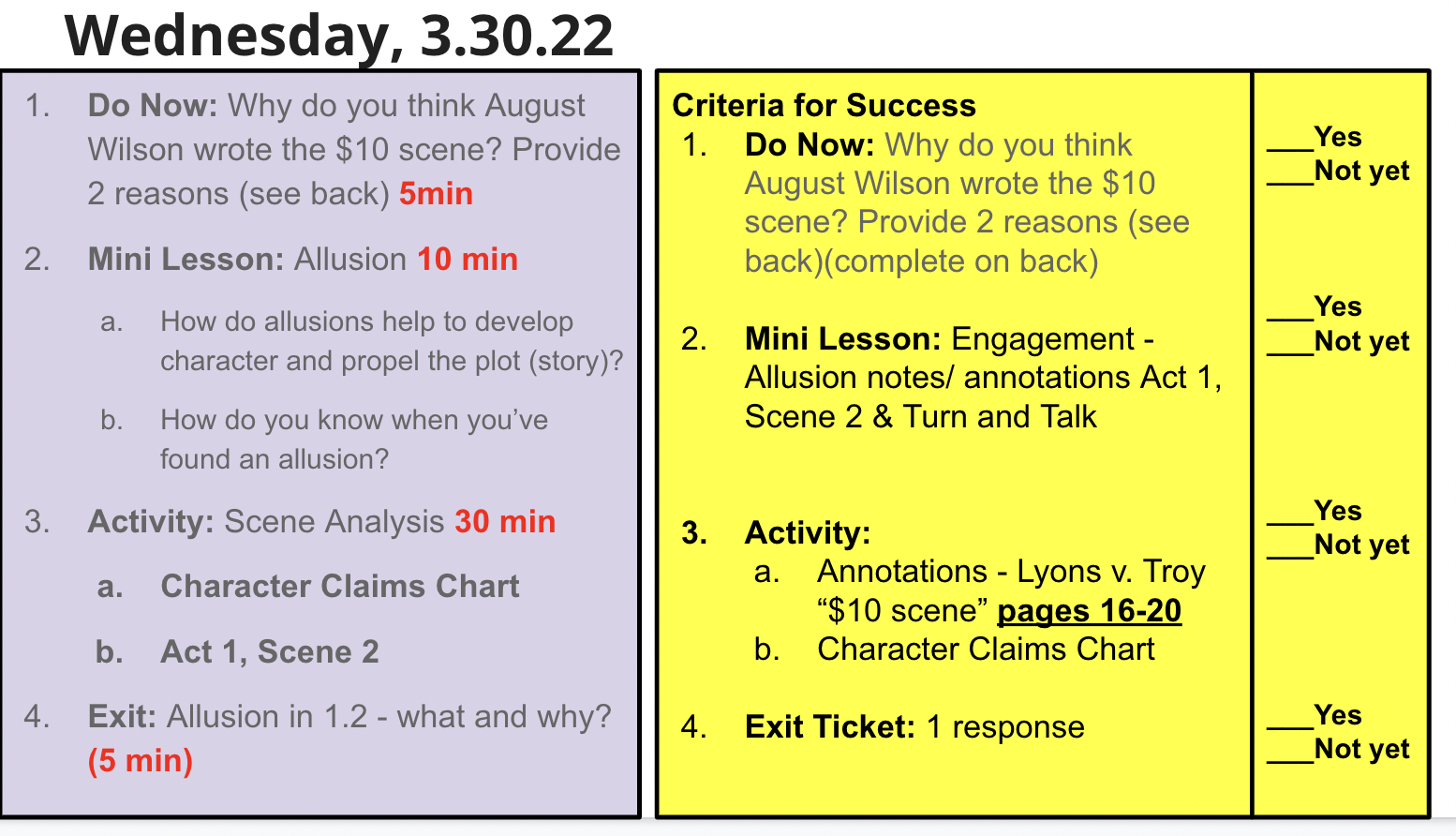
So, if a student didn’t write during the Do Now? Ok, it’s a “Not Yet”…But, here’s how it sounds as feedback to make that “Not Yet” worthwhile:
“I notice you marked “yes” for your work with the mini lesson. Tell me about what made yo choose “yes” for that part of the lesson. … So, now, tomorrow, what’s one thing you can take from your mini lesson work to the Do Now to make that a “yes,” too?
Continue reading “What does a “win” look like for Discourse Communities?”
 180newbeginnings.com