How Teaching AI Bias Exposed Obligation & Opportunity in My Lessons

The lessons I taught in the “before times” lost relevance and impact in 2020 Zoomlife. I had to do it differently. Something clicked for me when I listened to Manoush Zomorodi’s interview with Joy Buolamwini on NPR’s Ted Radio Hour. And this question (also the segment’s title): How Do Biased Algorithms Damage Marginalized Communities? opened a door to a new opportunity. Algorithmic Bias. I asked my students the next day, “What do you think of when you hear ‘Algorithmic Bias'”? And this time, my students’ silence was a signal to me to ask differently.

Two years ago, and two months into the start of another year of Zoom learning, like many of us teacher folk, I hit a wall. I had only heard six students speak. I didn’t know what my students looked like apart from the avatar on a blank screen. While this isn’t unique to my teaching journey in Zoomland, it is the catalyst for my personal moment of “Okay, this isn’t working, so now what?”

Zoom or no Zoom, my school’s instructional focus still called for instructional dialogue in every class. Certainly a full believer in instructional dialogue, I still struggled to replicate the practice on Zoom. The feedback I received after my evaluator observed an AP Language Zoom lesson was to work on leveraging more student voice. I didn’t see how that was possible on Zoom at that time, but I would understand it months later when I took the leap into digital debates. My mind could not digest the act of “doing a debate” on Zoom–especially when students were not talking either in breakout rooms or in whole-class “discussions.” I knew how to do in-person debates, but the alternative felt impossible.

Here’s how it went down

“C’mon just say something.” (YES! Someone unmuted! I’m literally clapping.)

Then, in the chat: “Cloudy. Cloudy. Cloudy. Stormy. Cloudy. Hurricane. Yeah, pretty windy here. IDK, TBH IDC. Maybe sunny?

I don’t think I was the lone teacher who started Zoom class with the question, “What’s your weather (mood/feeling) today?”–a faux “circle” opener as social-emotional check-in. I held tight to the belief that ritual and routine helped students normalize the Zoom classroom.

So I was facing this wall of “So, now what?” and could not turn away from that pokey question. I felt the urgency to design lessons that held a deeper meaning and that matched the importance of our critical consciousness emergent of the Twin Pandemics: Racial reckoning + Covid. I felt passionately about the urgency required within my capacity as a teacher to do something with whatever tools I had to teach with at that time. I remember sitting in my kitchen, my dog panting next to me, staring at the Zoom screen with blank squares, and saying something like this (what I thought to myself every single day of teaching with my dog from my kitchen):

“This is the time. You are living this moment for the first time. We all are. Your experiences right now will be read and talked about by your grandchildren. We have never been here before.”

I went on for too long. Or, maybe not…I had no social cues to read. But I said this repeatedly with different words on different days. I felt it in my core. This time was an opportunity; no, not opportunity, obligation. I either choose to engage in this moment as an educator or keep it moving (in the other direction…backwards).

Making a choice is taking a stance in every lesson

I chose (and will always choose) the obligation=opportunity route. But my passion, intention, and sheer will were not producing results. Students were not just disengaged, I’m not sure they were actually present. (Side note: Fast-forward two years, and my Zoom 10th graders are now my seniors. They laugh about the Zoom Year and how much freedom they had to disengage if they chose to mute and sleep or mute and FaceTime or mute and…[fill in the blank].)

But then…Algorithmic Bias, Justice & The Poet of Code

The lessons I taught in the “before times” lost relevance and impact in 2020 Zoomlife. I had to do it differently. Something clicked for me when I listened to Manoush Zomorodi’s interview with Joy Buolamwini on NPR’s Ted Radio Hour. And this question (also the segment’s title): How Do Biased Algorithms Damage Marginalized Communities? opened a door to a new opportunity. Algorithmic Bias. I asked my students the next day, “What do you think of when you hear ‘Algorithmic Bias'”? And this time, their silence was a signal to me to ask differently. So I asked it like this instead: “What if you heard those two words apart from each other, like ‘Where have you heard the word algorithm before?’ and ‘Where have you heard the word bias?'” Their responses back to me in the chat were more than one-word answers for the first time since we started in September (and it was November). We then had a discussion between chat and actual talking about the impact of putting those two different words together– with two different contextualized meanings –to create a new meaning. This was a big learning moment for me, and I hope for my students.

Obligation & Opportunity in Action

Based on critical consciousness of systemic racism we are obligated as a society to re-contextualize our lived language–in this case the joining of the two words “algorithm” and “bias.” My students had not thought of bias as related to algorithms, but once they listened to Joy Buolamwini’s Ted Talk (How I’m Fighting Bias in Algorithms) and then her interview with Manoush Zamorodi, they not only understood the implications of algorithmic bias but pushed each other in a debate for the need for algorithmic justice. My students’ excitement that there is the option in life to be called a “Poet of Code” was matched by their exposure to Joy Buolamwini’s story: If she can simultaneously fight racism, and fight the algorithms that design and perpetuate an ingrained cultural bias, then so could they.

Through discussion that eventually led to a formal debate (YES, on Zoom!), my students recognized the fight in something so seemingly benign as an algorithm. The irony here was that we were doing this work within and among AI culture. My students (now as seniors who admit that social media became their only social structure in 2020 Zoomland) began to question the flipside to AI and social media in their lives:“Wait, you mean what you see on your ads are not the same as mine?” I shared ads that popped up in my social feed: lipstick for “mature” women and area rugs on Wayfair. They laughed, but then compared the ads they saw and dug deeper to question economic justice behind those ads.

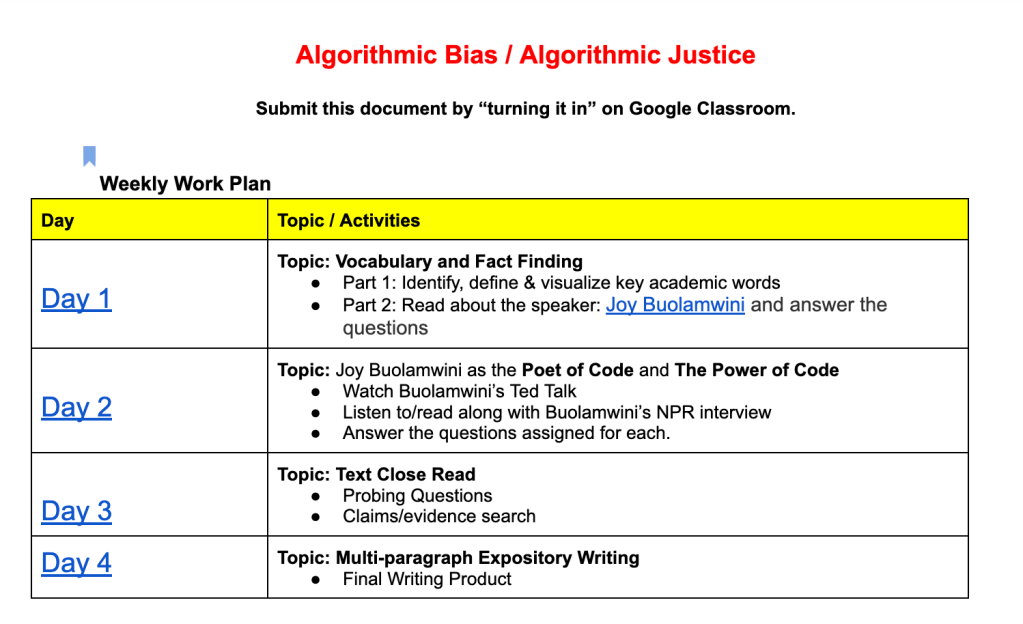
We Zoomed through this AI discovery together. Over a four-day lesson, and then a full debate, my students were ready to write a letter/email/article advocating for Algorithmic Justice. While some writers focused on social media and advertising, the majority of writers shared concern for racial profiling and systemic racism due to algorithmic bias.

One student shared the urgency of algorithmic justice like this:

What we’re experiencing now with bias in how algorithms are being written is like a fire alarm being pulled and no one coming to put the fire out. And the fire is literally burning some people and not others. Who’s going to put this fire out? I’m not sure it can be put out if not everyone sees it burning.

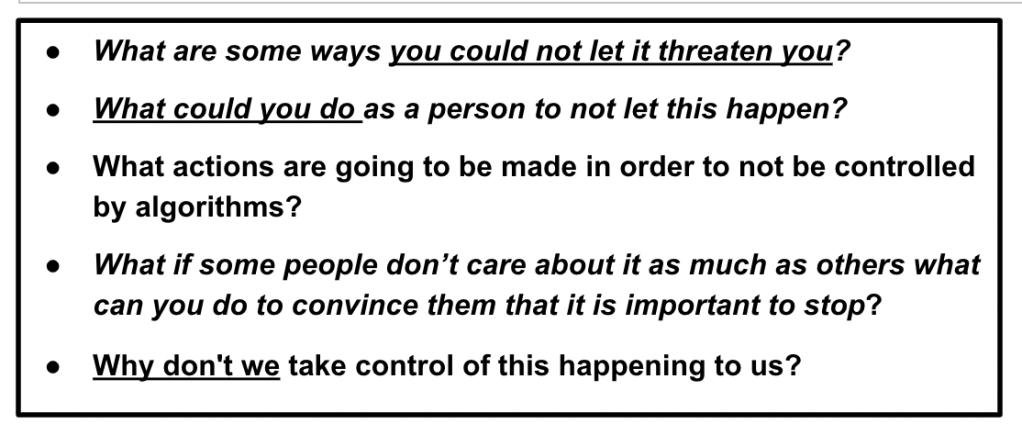
The debate prompt was challenging — a great opportunity for productive struggle through unpacking the prompt, writing about it, and then interrogating it with questions in their debate teams. Students who wanted more of a challenge opted for the “Con” side of this prompt, pushing themselves to argue the opposite of their own opinion, as I reminded them, they will do when they become lawyers. A good reminder that we debate positions, not opinions. (Check out more resources on debate for middle school, high school beginners/English Learners and a sample Debate structure for AP Language).

Students pulled apart and interrogated the debate prompt:
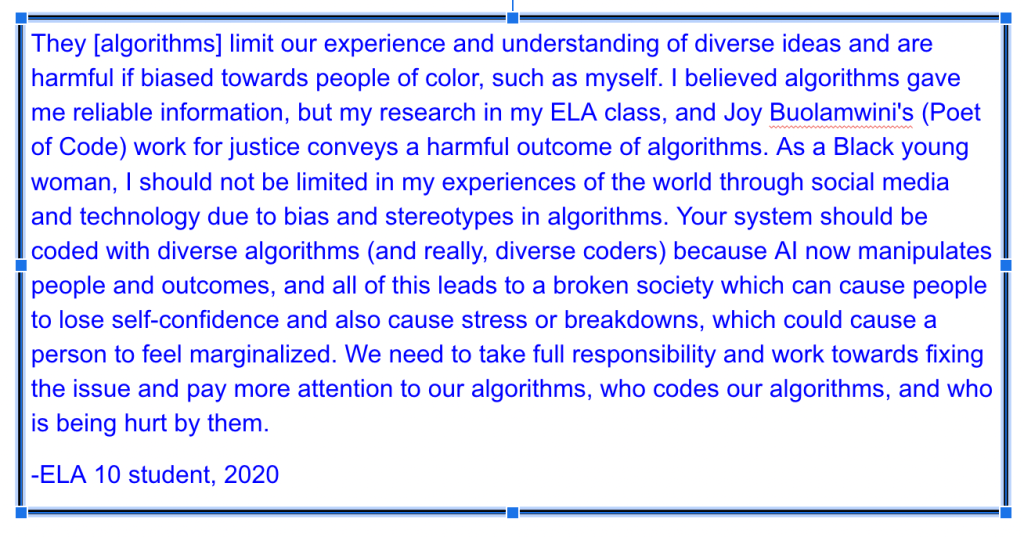
Another student wrote an email to Apple (excerpted below) for her advocacy writing, one of the steps in our Algorithmic Justice mini unit.
The catalyst for my change as a teacher–honoring the obligation and opportunity in each teaching moment–was hitting that Zoomlife wall of disengagement and pushing myself to question alternatives to what I had done before. The topic of Algorithmic Bias/Justice was a game changer for my students as it brought out their authentic questioning, as they grappled with concepts they had never encountered, and pushed each other by using evidence in debate. And, they got to know Joy Buolamwini, The Poet of Code, realizing that such a title and purpose exists.

I created the four-day mini unit and debate at a time when I new something had to change but had little time to make that change happen. It’s a starting point to understanding AI Justice and provided space for students to engage around a topic that they are still talking about two years later.
What now?

This December 20, 2022 Twitter post from The Algorithmic Justice League (@AJLUnited) calling for equitable

and accountable AI caught my attention just this week. What can I do as an English teacher to give space for AI justice in my classroom? I can’t help but admit that I missed an opportunity — am missing an opportunity as I write this– to do better with AI justice through action research writing, and further, through cross-curricular project-based learning. I can say that it is because my school does not have resources (time, staff, school design) to do cross-curricular work, or to take a side-step from mandated curriculum and testing to give students the chance to explore this issue. But, then, I reflect the obligation and opportunity on my part. The question I am grappling with for myself is: How can I break that proverbial wall and do this work in my classroom at a deeper level beyond what I could do/did on Zoom…with or without resources to support that work?

But, here’s the missed opportunity, and one that I hope to build in the future:

What if we were able to break the walls between disciplines and align ELA, Math, Science, Art, Business, and History to engage students in action research and problem solving through design challenges? Importantly, teachers need to have time and space to plan for cross-curricular impact. As I think about full circles (2020-2023) and reflect on how far my students have come in two years despite Zoom, I also think about my role as an educator to not just “Keep it Moving” but to stop and honor the obligation and opportunity to make learning about AI Justice a thing we do. The “wall” will always be there for an under-resourced school like mine, but so will that intentional teacher choice to do something different for students who deserve to know they can be a Poet of Code if they want to be.

#AIJustice #AIHarm #AIBias #ELATeacher #ActionLearning

What does a “win” look like for Discourse Communities?

If I really step back and see it from students’ perspectives, I see the equation does not add up. I talked in discussion but I don’t see the “A.” How can I re-contextualize for students what it means to “do” discourse: what does discourse look and sound like and how does that translate to a grade?

…Let’s Start with a Criteria for Success.

“Miss, what’s my grade? I did your work, but you didn’t give me points for class.” I have myriad responses to these questions: “You did your work, not my work.” But, that’s snarky, unfair, and limited. If I really step back and see it from students’ perspectives, I see the equation does not add up. I talked, but I don’t see the “A.” How can I re-contextualize for students what it means to “do” discourse: what does discourse look and sound like and how does that translate to a grade?

When I think about rigor in a discourse community, I want to simplify expectations to the basics: speaking, listening, reading, and writing. Too simple? That’s what I thought until I really dug into why my students truly believed they were in class and did the work, but didn’t “get the points” for discussion. “But I talked. I contributed.” How to begin the work of re-organizing what “talk” and “contributed” means in a rigorous discourse community? My current instinct: the basics. I use frequent formative assessments within each lesson against a clear Criteria for Success tied to objectives and standards from which to gauge student understanding. How do I gauge student understanding what it means to actively participate in a discourse community? I am still thinking through this question and changing my thought process with each lesson. I know it starts with a Criteria for Success.

My friend Chandler Smoak, a Chemistry teacher, is the ultimate Criteria for Success (CFS) guru; she implements and stays true to the structure of Criteria for Success in each lesson. I aim for that level of organization because it creates clarity for students, produced data that drives instruction, and contributes to the arc of a lesson. Taking Chandler’s lead, I learned to explicitly teach the daily Criteria for Success in each lesson and post the CFS on lesson slides. I include a printable version with a self-assessment component whenever possible. I focus CFS in my classroom by using it as a metacognitive benchmark to engage students in a self-assessment of their work…against the consistency and clarity of yes…the CRITERIA for SUCCESS. This metacognitive slice may be the turnkey for shifting students’ attitudes around what it means to be a “talker” and “contributer” in seminar, reciprocal teaching groups, and in group work in general that relies in promoting academic discourse. 

I love Kylene Beers and Robert E. Probst’s Notice and Note Sign Post close reading strategy and wanted to create a Criteria for Success that helped students track their Signposting progress. So I came up with two versions below. The one I kept for use the next time was the second version that asked for a “Rationale” with the starter “True because,” pushing students to back up their self-score.

Screen Shot 2022-12-29 at 12.55.55 PM
This is the first CFS – also functioning as a rubric
Screen Shot 2022-12-29 at 12.53.39 PM
And here’s the second version – with added space for students to document WHY the self-scored their work against the CFS.

Make Criteria for Success an action…like an actual VERB

Another version of Criteria for Success (below) is that each point is a verb: Talk, Listen, Record, Share. I try to keep the criteria to 3-4 basic points (and 4 might be too many). I include the CFS on each slide during the lesson and stop to do a check-in, asking students to focus on one of the four points in particular. Something like this: “Okay, so tell me what this group is observing with #1 – Talking.” When I design a lesson, I’m asking myself: How do students authentically engage with the CFS during a lesson so that it carries meaning for students as well as formative data for me? In other words, viewing the CFS as an action: What are students DOING to meet the success criteria? In this case, they had a CFS “card” or half-sheet of paper and self-scored against the 4 actions listed on the slide. I figured out the value of taking time during the lesson to benchmark against the CFS: it keeps me and my students organized to the lesson arc: Where are we going? How are we getting there? Every check in to a CFS is an opportunity for metacognitive development and the building blocks to a student’s self-agency with the process of learning.

So what about rubrics? Here’s where a CFS is not exactly a rubric in my thinking. A rubric, to me, is assessing how a student is progressing against standards and skills specific to a task. So, while students may be engaged in a discourse community activity, such as a Reciprocal Teaching Group for the play Fences, I want the CFS to reflect discourse success criteria and the rubric to reflect growth on meeting standards related to that text and task (i.e., tracing character over the course of a text; identifying two themes and how they interact, etc.). Now my thinking will certainly evolve on how I implement rubric and Criteria for Success, but that’s where I’m at now.

Another look at Criteria for Success & Getting Students to TALK

The slide below focuses on only three points — all geared towards our school’s instructional focus of “instructional dialogue/academic discourse” and “progressive questioning.” With this CFS, I am working with my ELA 10 class to understand the connectivity between SHOWING you are present through accountable talk. Ultimately, I want to get my students to #3 on this CFS – responding to questions or comments that pushes each other’s thinking. And that is hard. For me, #3–getting students to RESPOND with questions that PUSH each other’s thinking is THE HOLY GRAIL. I’ll get into that in another post; that is the work the keeps me going!

Screen Shot 2022-12-29 at 1.03.16 PM

These examples fundamentally set the tone of success within my classroom that academic discourse and engagement is a daily practice. This may seem elementary in a high school English class, but these examples are always at the core of Reciprocal Teaching groups, Literature Circles, Debates, and partner work. They are not, however, tied to new concepts, such as “I can identify motif and connect motif to theme.” As a learning objective, I see that as a benchmark to meeting or exceeding the lesson’s standard, and the way I assess and track how / where students are with meeting the standards is through specific formative assessment and feedback on that standard. I’ve found the most value in CFS in establishing an ever-evolving discourse community in my classroom–one that is assessing the practice of peer-to-peer questioning, building, listening, and facilitating evidence-based dialogue.

Screen Shot 2022-12-29 at 1.05.27 PM

Criteria for Success as “Mini Wins.” A Goal Maker.

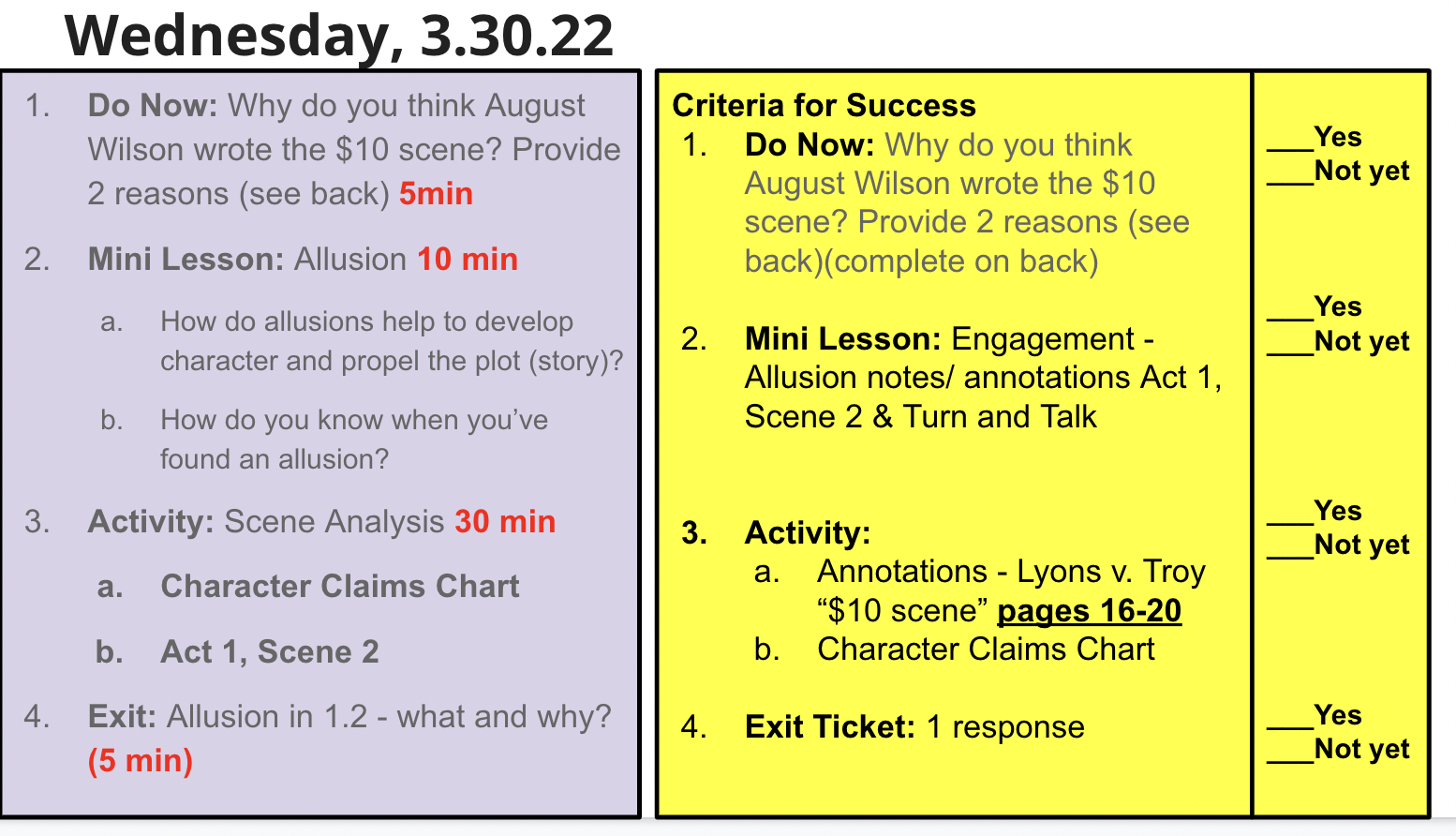
I experimented with a Criteria for Success that aligned to each part of the lesson, isolating each part for students to self-assess for “mini wins.” This became a helpful tool for a class that struggled to maintain engagement throughout an entire lesson. I give students this slide on a half-sheet (the Do Now was the other side), and then students monitored the CFS check list with either “Yes/Not Yet” as we move through the lesson. This worked great with this particular ELA 10 class because it allowed for a quick stop-and-pause-and-reflect, providing a time marker for students and a new opportunity to meet the success criteria with each different part of the lesson.Screen Shot 2022-12-29 at 1.04.02 PM

So, if a student didn’t write during the Do Now? Ok, it’s a “Not Yet”…But, here’s how it sounds as feedback to make that “Not Yet” worthwhile:

“I notice you marked “yes” for your work with the mini lesson. Tell me about what made yo choose “yes” for that part of the lesson. … So, now, tomorrow, what’s one thing you can take from your mini lesson work to the Do Now to make that a “yes,” too?
Continue reading “What does a “win” look like for Discourse Communities?”

How My ESL 3 & 4 Students Revised My Thinking on Teaching Debate

It was a real debate. It had an order that established expectations, but it was messy because it was real. Students believed in the process and their own part in owning that process.

Sometimes, it’s good to scrap those painstaking plans and give in to your students’ requests for “but please–just one more day!”

My ESL 4 students  were making their case for extending our final assessment to “just one more day.” I had planned for two hours of a debate, including everything from opening statements that were carefully pre-written in legal teams and practiced like a formal speech prior to debate day, cross examination sessions, team meetings, time-outs for researching additional evidence, and closing statements.Screen Shot 2022-12-29 at 11.56.51 AM

I started in-class debates when working with The Boston Debate League in my 10th grade ELA class and have tweaked the format over the years to extend the cognitive demand in different areas. Debates are dramatic play with students fully bought-in as they take on roles of Pro and Con or Defense and Prosecution.

This past year I adapted the debate structure I’d used in my ELA classes with a debate arguing for or against raising the minimum wage. Where I had always used debate as summative assessments of literature, this debate called on using informational texts and data the way my ELA debates used literary text as evidence. This adaption required skills in reading and synthesizing informational texts and also the agility to flip perspectives quickly in a debate to understand the argument “inside out” to develop counter arguments during the cross-examinations.

I spend a lot of time explicitly teaching questioning to further develop reasoning of an argument…and, to do this using text. This takes practice in many forms across discourse, reading, and writing. So when my ESL3 and 4 students pleaded for “just one more day” of debate, I did not hesitate to change my plan. This was a rich assessment: embedded in the curriculum, it was based on a sequence of formative assessments and aligned to standards. It reflected a clear Focus Language Goal and demonstrated growth in knowledge and skills. It required collaborative reading, writing, and thinking using complex text. Students had to listen carefully to each other, synthesize information, and redirect thinking in-the-moment.

The best part: It didn’t feel like a test. It was a real debate. It had an order that established expectations, but it was messy because it was real. Students believed in the process and their own part in owning that process. This, in my mind, is student-centered learning because it’s managed and enacted by students. Students push one another for evidence–they are choosing to not only engage as students taking an assessment but as decision-makers in a learning experience.

This is just one page from the Debate Packet that provides an organized space for students to record their attack questions (we attack with questions only). In my ELA 10 and AP Language classes students no longer require the scaffolding of “pause + think + talk + write” in order to craft attack questions and respond to opponents’ questions. This is a great scaffold to get students to the point of extemporaneously attacking and defending as a team. You can check out the full Debate Packet here. Screen Shot 2022-12-29 at 11.22.54 AM

What worked really well was dividing the Closing Statement into four questioning segments to get students to really think through their final points. In a collaborative “huddle” students talked and wrote through their closing statement while practicing a concession (#1 below) as well as recalling their strongest evidence. This Closing Statement organizer empowered students to stand before our judging panel and read aloud their planned writing.

Discourse as Discovery: Debate, Trial, and Performance with The Odyssey

I had the opportunity to work with the Boston Debate League (BDL) through their Evidence Based Argumentation (EBA) program for two years with the help of EBA instructional coach, Sarah Mayper. Sarah supported my efforts in transforming lessons from static to dynamic through EBA activities that promoted student-to-student discourse grounded in evidence and reasoning.

Once I got the hang of transforming traditional, static lessons that I had relied on for years, I began to experiment with ways to leverage EBA strategies “off the page” to engage students in debate. Although intimidated at first to release the entire lesson to students in a whole-class debate, I realized that the structure of the debate protocol provided the necessary supports for students to feel in control of their own work. I saw students who had presented reluctant or resistant behaviors turn into passionate and empowered debaters, who hungrily searched the text for the right piece of evidence at the right moment to defend an argument.

A debate team representing Rose from Fences revises its opening statement in debate prep.

IMG_4154 Continue reading “Discourse as Discovery: Debate, Trial, and Performance with The Odyssey”