Consensogram: Visualize Student Beliefs, Build Community & Launch New Learning

Looking for ways to launch a new unit or text, leverage prior knowledge, create community, and showcase thinking? Here it is: The Consensogram–a visual learning strategy where students create a bar graph of their thinking.

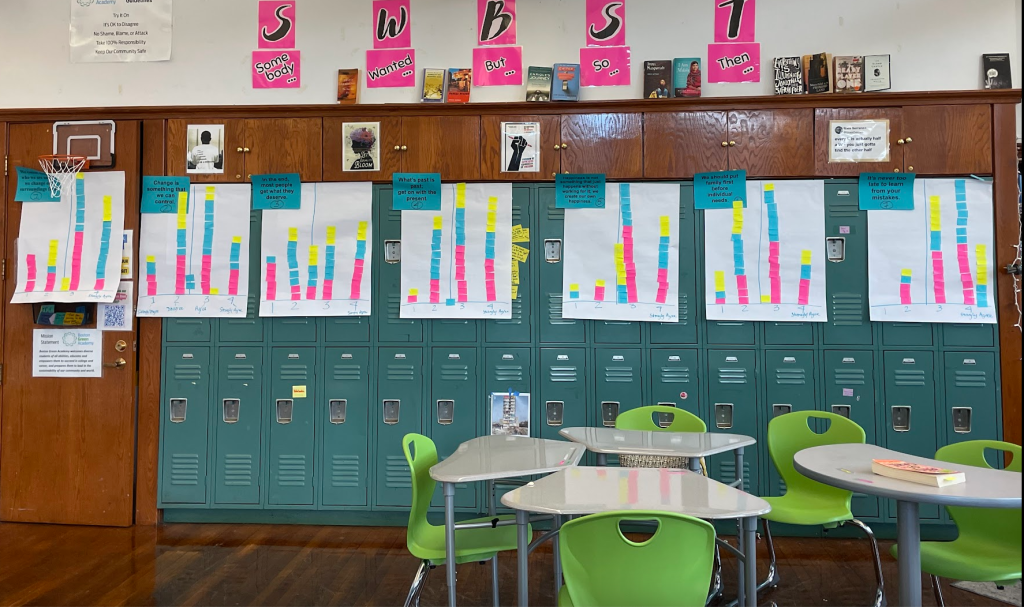
Looking for ways to launch a new unit or text, leverage prior knowledge, create community, and showcase thinking? Here it is: The Consensogram–a visual learning strategy where students create a bar graph of their thinking. I use it as a unit opener, offering students the unit’s essential questions and themes as debatable statements. Together, as a class community, their individual perspectives on these debatable claims form a “Consensus” in the form a visual bar graph. The Consensogram is a powerful tool that can be used as a unit opener or launch of a new text. It can also be used as a formative check for understanding mid-unit. I’m always searching for a novel way to facilitate immersive learning with the goal of taking the work “off the page,” and the Consensogram does just that. It adds a new layer of depth and engagement to the traditional “anticipation guide,” and it can be used effectively to facilitate discussions and debates.

Understanding The Consensogram

It’s a different way to stimulate thinking, create discussions, and engage students effectively. One of the unique aspects of the Consensogram is the way it can be used to visualize and analyze thinking as data. It encourages peer questioning, whole class discussions, and even Socratic Seminars. The final product can be displayed throughout the text or unit of study, and can be referred back as the class works through essential questions and develops themes. As an added bonus, it catches the eye and interest of the room. At the end of the unit, students can return to the Consensogram to compare their agreements and disagreements as a reflection of how their thinking and understanding of unit themes and concepts have evolved.

The Consensogram can also be used anytime you want students to think about their stance on a topic. All you have to do is choose at least 2 debatable claims, evidence, or ideas for students to think about and apply to their own beliefs.

Implementing the Consensogram: What You Need

The set up is worth it! Here’s a guideline to help you get started:

  • Choose 5-8 debatable statements, ideas, or claims related to the text or unit’s universal ideas, themes, and essential questions.
  • Print each statement in large text on a piece of chart paper and tape it to the top. Draw a line down the center of the chart paper in marker and draw a horizontal line at the bottom. Write the numbers 1, 2, 3, and 4 under the bottom horizontal line with numbers 4 and 3 to the left of the vertical line and 1-2 to the right.
  • Prepare small sticky notes, ideally 1×1. Use a different color for each class to help students analyze data across classes the next day.
  • Each student receives the number of sticky notes matching the number of claims or posters. If there are 8 claims, each student will receive 8 sticky notes.
  • Ensure the numbers (1-4) you are using on the agreement spectrum (1=strongly disagree, 2=disagree, 3=agree, 4=strongly agree) match the numbers on your chart paper.

Immersive learning takes set up, but the pay-off is student engagement.

Step 1: Reflect and Rank Debatable Claims

One of the reasons I am a Consensogram fan is that it leverages students’ prior knowledge, allowing the space to jump in with their own belief system. There are several ways you can facilitate this first step:

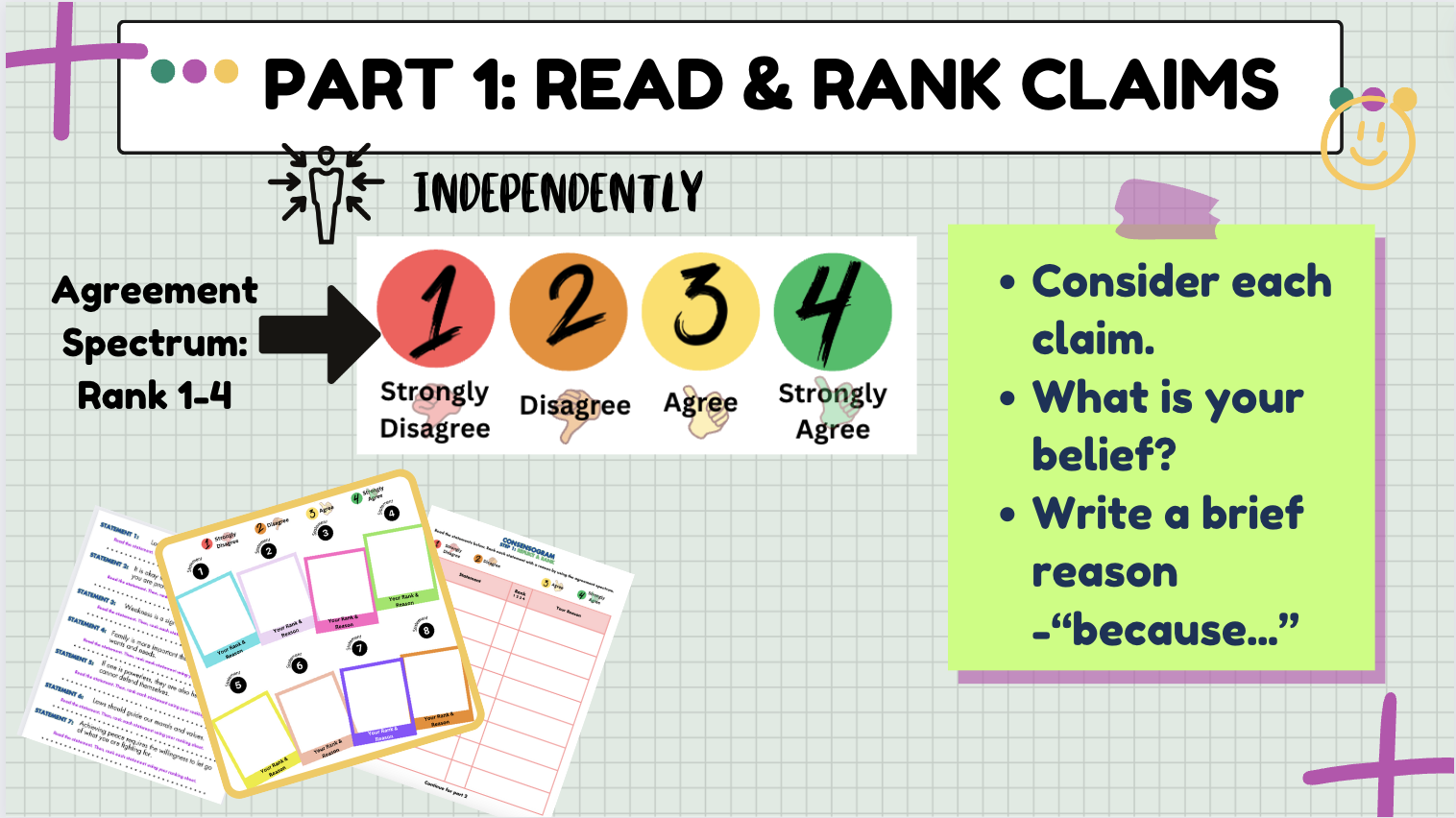
One option is to use a traditional “Anticipation Guide,” where the debatable claims are printed on the guide and students indicate their level of agreement using a scale from 1 to 4, ranging from strongly disagree to strongly agree. Students can complete the Anticipation Guide with or without providing reasoning for their beliefs.

Alternatively, you can provide the claims separately on paper or project them. I am a manipulatives person, so I cut the eight claims into laminated slips for each student and re-use for all of my classes. That way, I can even save them for next year when I introduce the unit again. Students think about each claim and record their level of agreement and reasoning in picture frames. This simple change from the traditional Anticipation Guide adds a bit of novelty, and for my students, novelty equals higher engagement.

Step 2: Add Sticky Notes to Chart Papers

Once students have ranked the claims, they add their sticky notes to chart papers according to their level of agreement. For example, if a student selected 2 (disagree) for statement #3, they would go to the chart paper labeled with the claim and number “3” and add a sticky note above the horizontal line belonging to “2 – Disagree.”

Remind students to place the sticky notes vertically and not to cover anyone else’s note. By using a different color sticky note for each of your classes you can track class trends and dig deeper into the data your students create. Tip: ask each student to write their initials on the note to track engagement.

Step 3: Partner Discussions

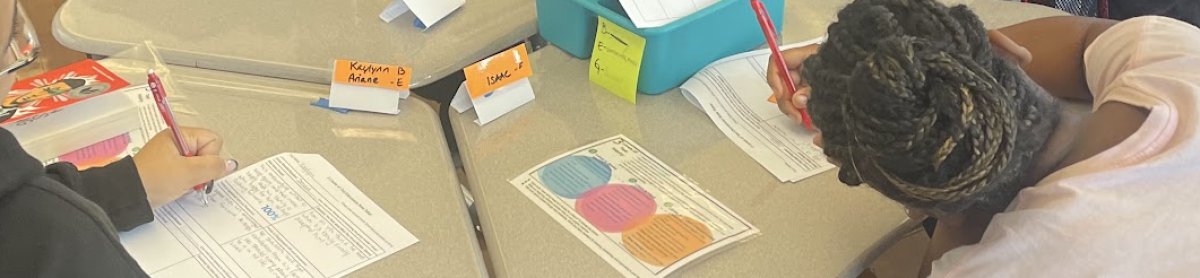
Next, students find a partner and work through discussion cards. These cards are adaptable for any activity and can be laminated for reuse throughout the year. The partner work provides a helpful scaffold to the Socratic Seminar or whole-class discussion in Step 4, allowing quieter students to problem solve and process 1:1.

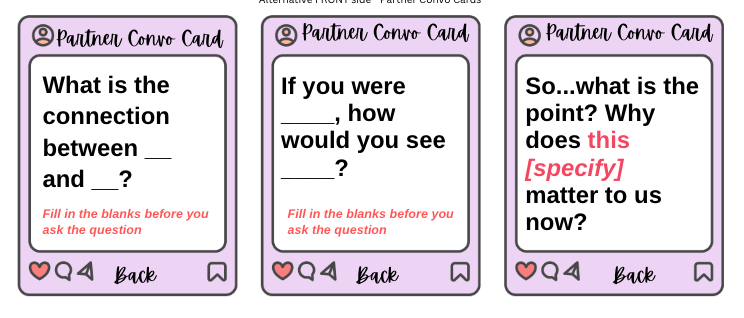
In my Consensogram resource, I provide two different discussion card sets. One version of the cards has students work through questions with the same partner. Another version of the cards has only one question on the card: students ask and answer each other’s question, then trade cards before finding a new partner and a new question to discuss.

Step 4: Circle Discussion or Socratic Seminar

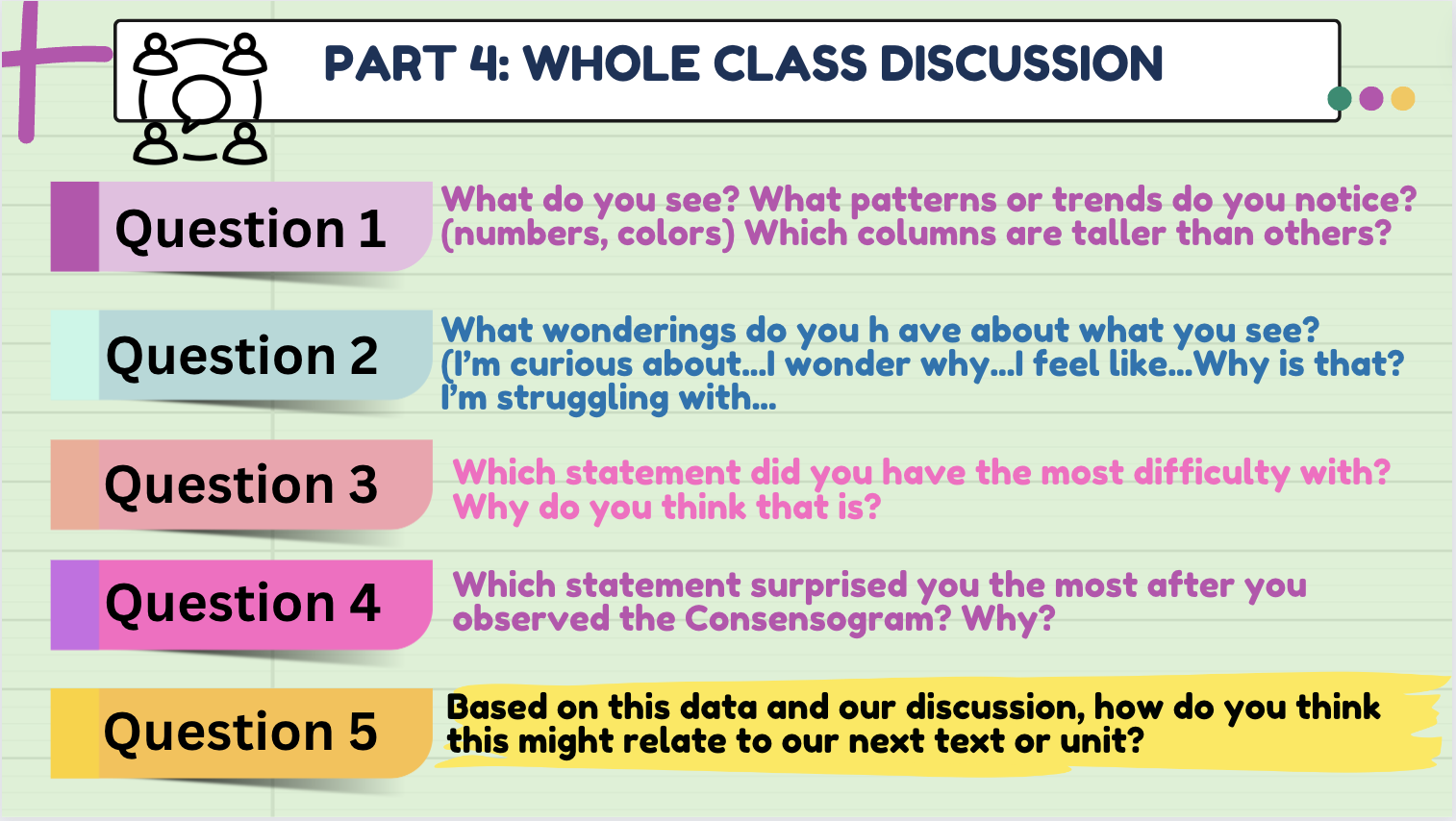
Finally, students gather together for a circle discussion or Socratic Seminar, working through the five questions on the activity handout. The whole-class discussion questions are designed to move students through higher DoK questioning from “What do you notice?” to “What might trends in our thinking or points of disagreement/agreement mean?” to “What are the implications of this data?”

Encourage students to notice and talk about their Consensogram as collected data representative of their shared belief system and different perspectives within your class community. Students walk away with making connections between the evidence/data and synthesizing the class’ collective responses and with even more questions and excitement as we start new learning.

So, next time you’re looking for a novel way to get your students thinking, consider trying out the Consensogram. Happy teaching!

Adding Student Voice to Dr. King’s “What Is Your Life Blueprint” Speech

Dr. King’s “What Is Your Life Blueprint” speech gives a different perspective to King’s rhetoric. My students are immediately pulled in to his message when they watch him deliver the speech to middle school students. His words, supported with vivid images and strong metaphors, speak directly to students.

With the mission of getting Dr. King’s words off the page, I transformed the way I taught the rhetorical situation through this speech. Each activity centers student voice and agency in Dr. King’s message of finding and sticking to your life’s path no matter what obstacles stood in your way.

Tableau or Spoken Word Performance

Tableau and spoken word performance is the ultimate engager as students to physicalize with feeling Dr. King’s rhetoric. This trio created the image of the “crystal stair” in the speech and gave a passionate, from-the-heart mini performance. With just a small bit of text, and in under 1 minute, students can focus in on one or two images to create either a still picture in a tableau or a performed mini scene, putting voice to text. Students feel the alliteration, repetition, and rhythm in a way that cannot be replicated by silent reading.

Discourse Builder Roundtable Discussion

What it is: Join 4-5 students together to practice accountable talk and close reading. This is called a “discourse builder” because students are tasked with using probing questions to add on to what each person offers in discussion. This discussion focuses on close reading. Each student receives a text selection from the speech as a “mystery text.” I call it a mystery text to build anticipation before we read.

Why it works: Student voices are central to this activity just as student agency. They are not only engaged in discussion with each other, but each person gets to lead the discussion for their specific text selection. This builds excitement and serves as a scaffold to reading the full speech as students have already chunked and analyzed language in their “mystery text” slices. At the end of this activity, they have made and shared personal text connections, built community through shared ideas, questioned the text, and are familiar with unknown words, writing style, and message. And all before we even read!

The strategy:

Step 1: I select 4-5 chunks of text, focusing on excerpts with a significant amount of unknown vocabulary, complex sentence structure, imagery and metaphor that connect back to Dr. King’s message. I also make sure to differentiate text so that some selections are more easily accessible. I like taking selections from beginning, middle, and end of the text so that students get a sense of the arc of the speech before they read and can say “I know this!” when we get to the full text.

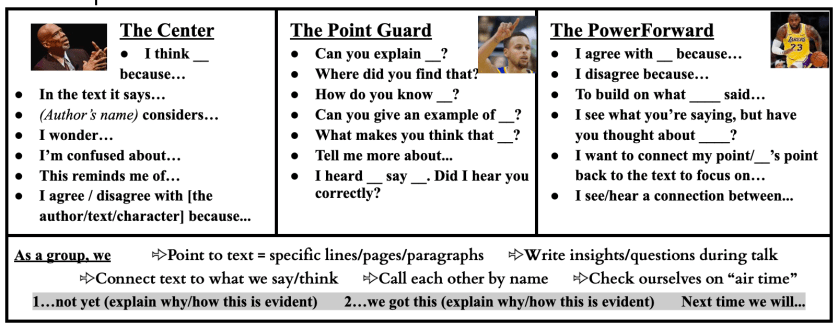
Tip: Point students in the direction of probing questions to focus and redirect accountable talk moves. I have on hand laminated probing questions cards. For my tenth graders, I love the “basketball question cards” that divide probing questions for accountable talk into three roles: Point Guard, Power Forward, and The Center. Students can’t miss these bright green cards in the center of the discussion.

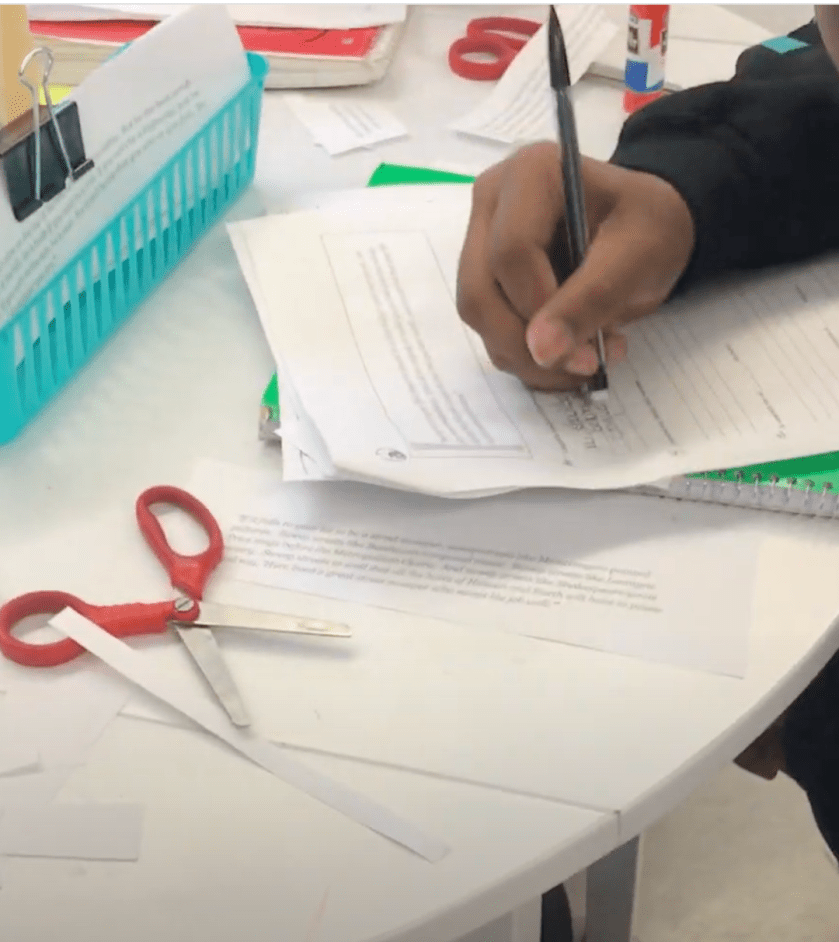
Step 2: Cut up the text selections, making a set for each student group. Each group receives a “Discourse Builder” handout (linked here for free) with boxes for each text selection. I love manipulatives and any opportunity for hands-on engagement. Students glue in each text selection as they work through the activity. Each student is responsible for one of the text slices. They read their slice independently, making personal connections and questioning the text. In a round table discussion, when it is time to lead, each student shares their connection and questions to the table and leads a discussion about their text slice using probing questions.

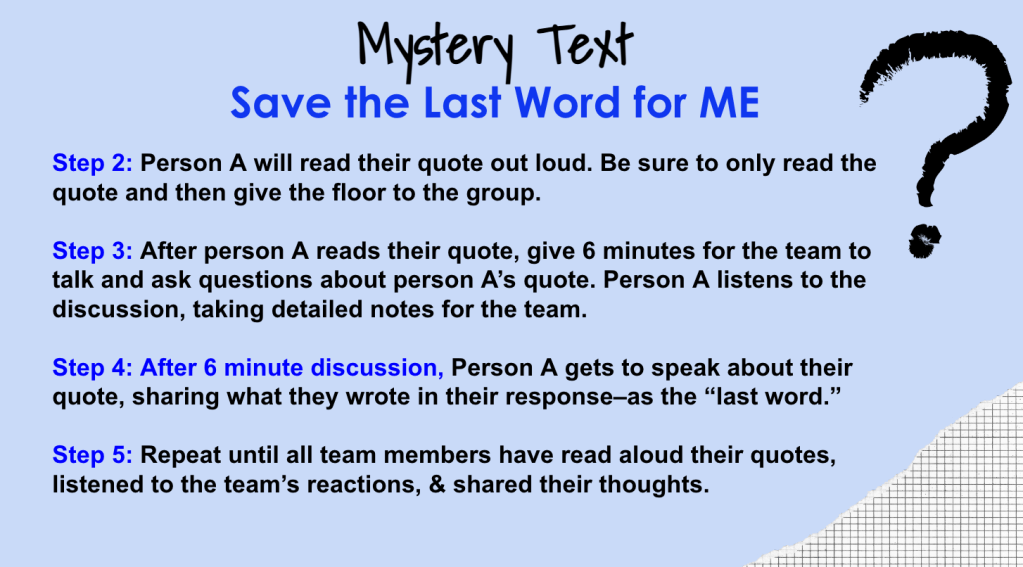
Save the Last Word for Me

What it is: Similar to the Discourse Builder Roundtable, Save the Last Me provides opportunity for accountable talk with a focus on listening to learn. This is a great replacement option to the Discourse Roundtable if you are using it as a pre-reading activator with “Mystery Text” quotes. It also allows students to zone in on specific parts of the text during reading and as a reflective exercise looking back on the entire text post-read.

Why It Works: This is great for students who don’t like going first as it allows time for processing — the initial first step as the discourse leader is to read the quote and then step back and take notes to capture what the groups says in response. I love this strategy for building strong listening. It’s also a helpful exercise for students who struggle to monitor air time in discussion as it provides a structure for holding back to let other speak.

3 Levels of Text Discussion

This is another great discussion framework that facilitates text-to-self and text analysis through close reading. Read more about how to do this in your classroom here. The resource can be found here.

Reflective Writing Responses

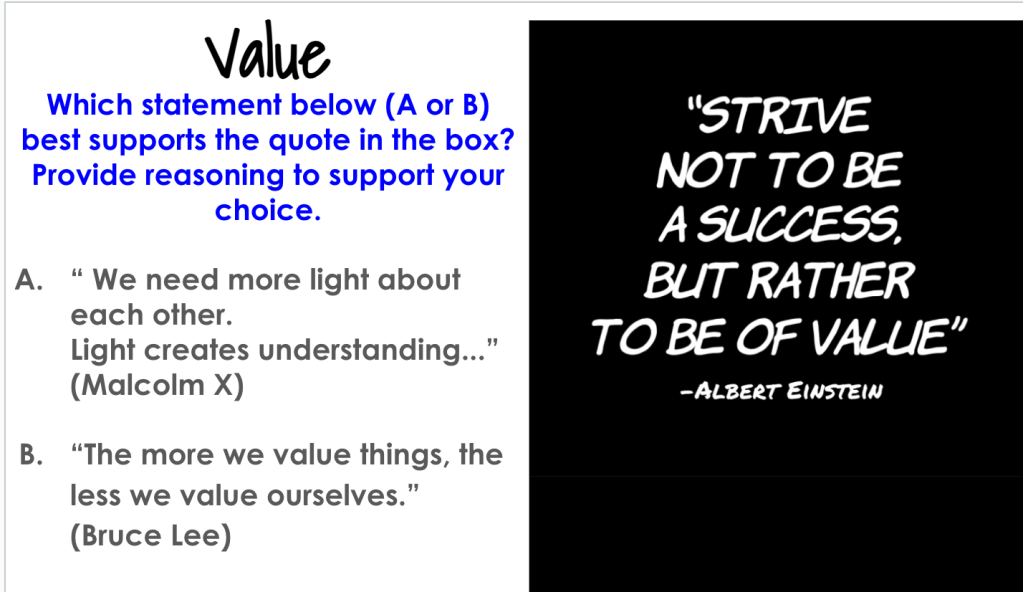
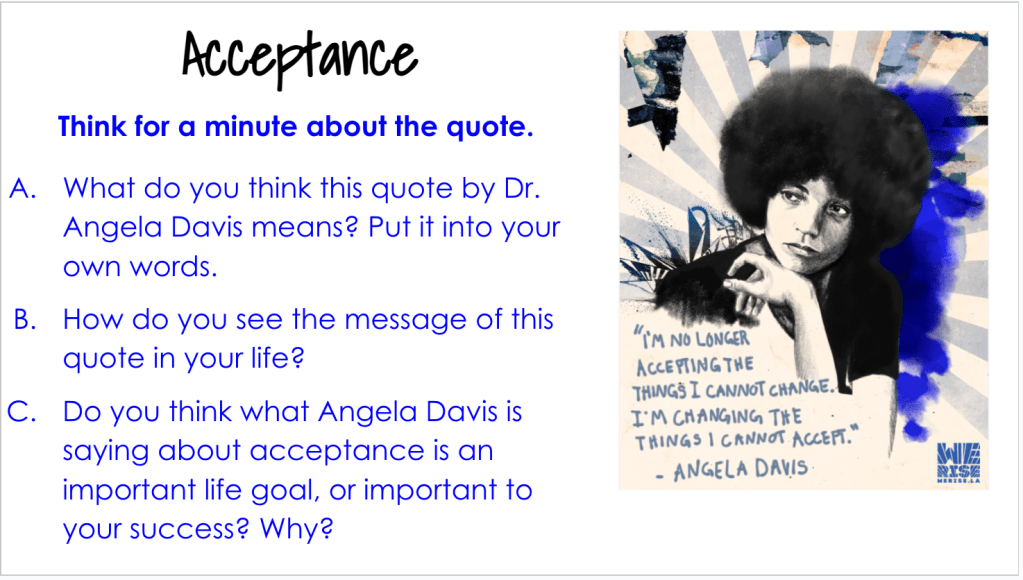
What it is: Sometimes I call this “meditation” writing. Getting students to think about their thinking, building metacognition in reflective writing, also builds writing stamina as students learn to flex their reflective muscles. While my students read Blueprint, I integrate quotes relating to Dr. King’s message in the speech focusing on success, failure, adversity, tenacity, etc. from Audre Lorde, Angela Davis, Malcolm X, to name a few.

Why it works: These prompts are great discussion points on their own and create a nice compare/contrast analysis with Blueprint. The prompts work well because of universal themes, but also because they push students to compare and contrast–and synthesize–ideas from different voices. Here’s a few from my slide deck below. The full slide deck with 11 prompts can be found here.

Close Read with Purpose

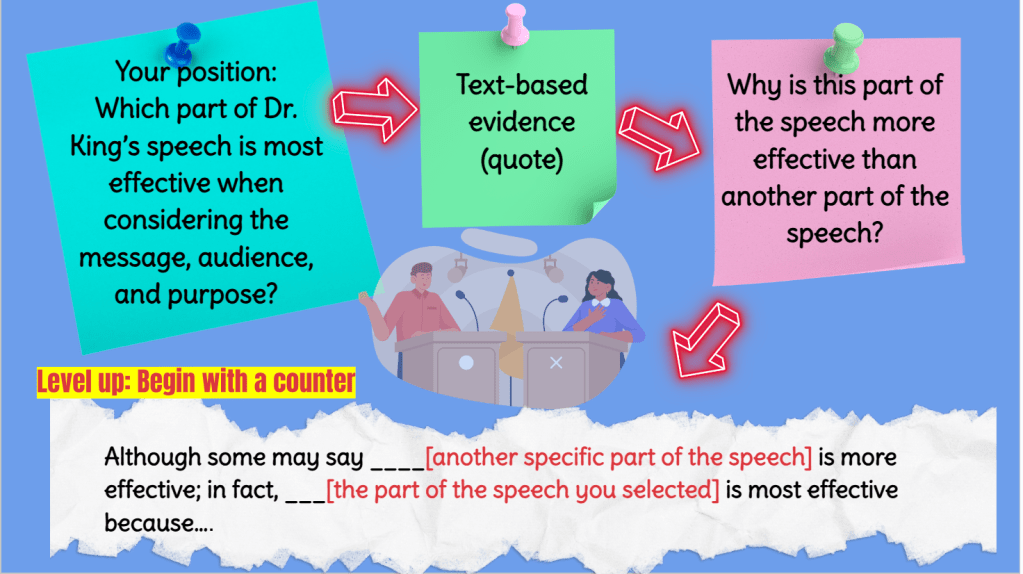
What It Is: Before they read, I tell them that their reading mission is to determine which part of the speech (chunk 1, 2, or 3) is the most effective given Dr. King’s message and audience. This becomes the question for a debate or socratic seminar post-reading.

It’s important for students to learn to read for message (what the writer wants) and understand the relationship between message and audience/reader impact. After the pre-reading activator Mystery Quote activity, I introduce the concept of message and audience through the lens of universal ideas. It’s important for students to base their reading or analysis in universal ideas rather than facts or evidence. It helps students move from “What happened” to “So What” about what happened. Check out my free Universal Ideas lesson here. As a tenth grade, Pre-AP and AP Language teacher, universal ideas are the groundwork for analysis and prevent reliance on plot summary.

Why It Works: My reading go to is Reciprocal Teaching Groups, or variations of RTGs, where students read collaboratively to build meaning. In collaborative reading groups, students either work with Task Cards or with specific reading look for’s. This mission-focused reading sets up close reading with purpose and helps students to self-manage the text. Collaborative reading helps students process multiple look for’s simultaneously and pushes students to build stamina with a multi-step reading process. I have found that students are less likely to give up if they have a role to fulfill and are accountable to a reading group.

How: I have a digital version of Blueprint that is color-coded by three sections (beginning, middle, and end). It includes guided reading questions in a format that visually separates text for readers who learn better with sight markers to break apart the text. Color coding, or breaking the text into distinct parts, chunks the text with purpose. For paper people (I’m still in that bunch), a non-color copy is numbered into three sections, and students can box-out each section in different colors to visually code the text before they read.

Blueprint is rich in metaphor and imagery. A good starting point would be to talk about the title, connecting “blueprint” with the reflective writing prompt themes or messages, metaphors, and imagery that stood out to them from their Mystery Quote pre-reading activator.

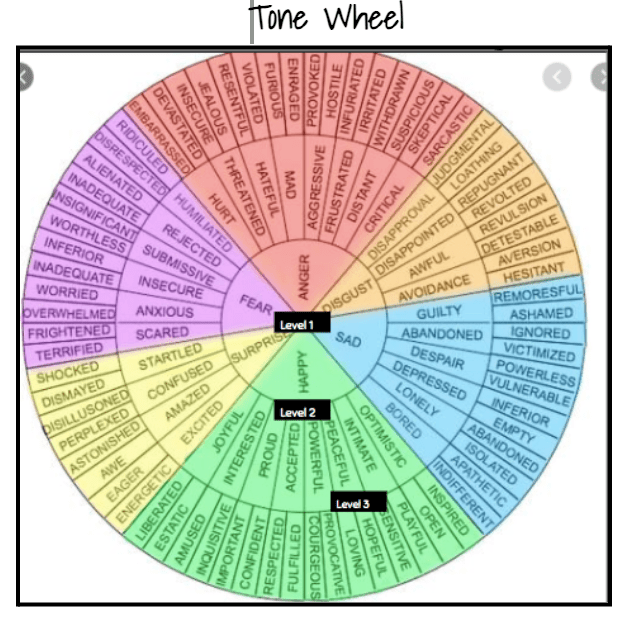
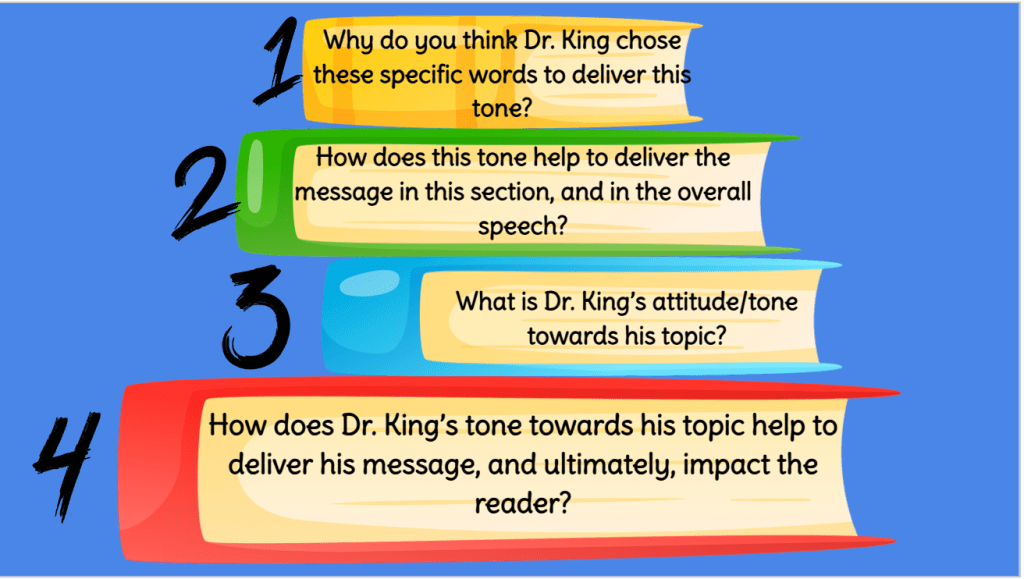
This speech is a great way to introduce or reinforce the idea of tone as the author/speaker’s attitude towards their subject or topic. I find that students can easily spot tone when reading fiction and analyzing a character’s tone, but with speech analysis, students are learning to “read like a writer” rather than their life-long habit of “reading like a reader.” It’s really a flipswitch moment for a lot of students. This free “SPACECAT” resource is a great tool for rhetorical analysis. This “Read Like a Writer” lesson on diction and tone is also a good next step in rhetorical analysis. Check out my bundle of “Read Like a Writer” resources.

Here are some questions about tone and message to guide reading like a writer:

A tone wheel (honestly, I would wear this tone wheel every day–that’s how much I use this in writing and reading) is linked in the reading and helps students attach Dr. King’s language choices to tone. It also sets up a nice follow-up question for students to dig in deeper.

Synthesize Ideas with Socratic Seminar or Debate

Students take their reading purpose question and prepare a position statement or response for seminar or debate.

Level up debate through these moves:

  • Give students a position to defend. Students may at first question how they will debate a part of the speech, but building their argument muscle can begin with framing the parts of King’s speech as being defensible.
  • Adding in the “message and audience” as parameters can raise the cognitive demand as students must apply their knowledge of both to build a case for the part of his speech that is “most effective.”
  • The demand is increased even more when students push their argument to include how their selected text is more important than the other parts of his speech.

Check out more debate resources here.

This debate question can also apply to a Socratic Seminar discussion as students prepare text to support their position on the prompt. I’ve designed Seminar pre-work for students to verbally share their thinking with a partner before writing independently to prepare for the group Seminar.

Blueprint Lifts up Student Voice

This speech empowers students to connect to Dr. King’s message. The structure outlined above engages students even before they read the entire speech as each student leads discussion of a part of the text and makes it their own. It’s powerful to watch students enter the world of this speech and without even knowing it, they have learned the rhetorical situation through student-led discussion, close reading for metaphor and tone, and defending parts of the text against a claim in debate or socratic seminar.

I’ll end with a student’s observation of his “Mystery Text” selection during the Discussion Builder Round Table:

“If you are going to be at the top of the game, or at the bottom. Whatever you’re doing, going up a hill, playing ball, swimming, whatever you got to do…You’re going to mediocre it or be at the bottom? You might as well just do it. When he says “scrub,” if you think about it…what could that relate to? Scrub is like negativity. I relate that to basketball. When you call somebody a scrub in basketball, you’re being disrespectful. But he said, ‘be the best scrub,’ so he’s saying even if you’re down and not doing good, give it your best. That’s what I do. I can relate to that.”

Resources in this article:

Dr. King’s Blueprint Speech full resource, including:

  • The Discussion Builder Roundtable (digital and print versions)
  • Save the Last Word for Me (+ colorful quote cards, writing space, exit ticket, and slides)
  • 11 reflective writing prompt slides
  • Dr. King’s Blueprint speech with 3 sections divided by color, guided reading questions, and links; Blueprint speech without color for printing, also with guided reading questions and separated into 3 sections with numbers.
  • Debate slides pictured above
  • Colorful tone wheel pictured above
  • Socratic Seminar pre-writing space + partner share cards
  • Socratic Seminar accountable talk tracker and individual reflection space

Basketball Accountable Talk Cards / Probing Questions

Debate Resources

free “SPACECAT” resource

“Read Like a Writer” lesson on diction and tone

bundle of “Read Like a Writer” resources

Free Universal Ideas lesson slides

3 Levels of Text Discussion

Free Discourse Group Roundtable handout

How Teaching AI Bias Exposed Obligation & Opportunity in My Lessons

The lessons I taught in the “before times” lost relevance and impact in 2020 Zoomlife. I had to do it differently. Something clicked for me when I listened to Manoush Zomorodi’s interview with Joy Buolamwini on NPR’s Ted Radio Hour. And this question (also the segment’s title): How Do Biased Algorithms Damage Marginalized Communities? opened a door to a new opportunity. Algorithmic Bias. I asked my students the next day, “What do you think of when you hear ‘Algorithmic Bias'”? And this time, my students’ silence was a signal to me to ask differently.

Two years ago, and two months into the start of another year of Zoom learning, like many of us teacher folk, I hit a wall. I had only heard six students speak. I didn’t know what my students looked like apart from the avatar on a blank screen. While this isn’t unique to my teaching journey in Zoomland, it is the catalyst for my personal moment of “Okay, this isn’t working, so now what?”

Zoom or no Zoom, my school’s instructional focus still called for instructional dialogue in every class. Certainly a full believer in instructional dialogue, I still struggled to replicate the practice on Zoom. The feedback I received after my evaluator observed an AP Language Zoom lesson was to work on leveraging more student voice. I didn’t see how that was possible on Zoom at that time, but I would understand it months later when I took the leap into digital debates. My mind could not digest the act of “doing a debate” on Zoom–especially when students were not talking either in breakout rooms or in whole-class “discussions.” I knew how to do in-person debates, but the alternative felt impossible.

Here’s how it went down

“C’mon just say something.” (YES! Someone unmuted! I’m literally clapping.)

Then, in the chat: “Cloudy. Cloudy. Cloudy. Stormy. Cloudy. Hurricane. Yeah, pretty windy here. IDK, TBH IDC. Maybe sunny?

I don’t think I was the lone teacher who started Zoom class with the question, “What’s your weather (mood/feeling) today?”–a faux “circle” opener as social-emotional check-in. I held tight to the belief that ritual and routine helped students normalize the Zoom classroom.

So I was facing this wall of “So, now what?” and could not turn away from that pokey question. I felt the urgency to design lessons that held a deeper meaning and that matched the importance of our critical consciousness emergent of the Twin Pandemics: Racial reckoning + Covid. I felt passionately about the urgency required within my capacity as a teacher to do something with whatever tools I had to teach with at that time. I remember sitting in my kitchen, my dog panting next to me, staring at the Zoom screen with blank squares, and saying something like this (what I thought to myself every single day of teaching with my dog from my kitchen):

“This is the time. You are living this moment for the first time. We all are. Your experiences right now will be read and talked about by your grandchildren. We have never been here before.”

I went on for too long. Or, maybe not…I had no social cues to read. But I said this repeatedly with different words on different days. I felt it in my core. This time was an opportunity; no, not opportunity, obligation. I either choose to engage in this moment as an educator or keep it moving (in the other direction…backwards).

Making a choice is taking a stance in every lesson

I chose (and will always choose) the obligation=opportunity route. But my passion, intention, and sheer will were not producing results. Students were not just disengaged, I’m not sure they were actually present. (Side note: Fast-forward two years, and my Zoom 10th graders are now my seniors. They laugh about the Zoom Year and how much freedom they had to disengage if they chose to mute and sleep or mute and FaceTime or mute and…[fill in the blank].)

But then…Algorithmic Bias, Justice & The Poet of Code

The lessons I taught in the “before times” lost relevance and impact in 2020 Zoomlife. I had to do it differently. Something clicked for me when I listened to Manoush Zomorodi’s interview with Joy Buolamwini on NPR’s Ted Radio Hour. And this question (also the segment’s title): How Do Biased Algorithms Damage Marginalized Communities? opened a door to a new opportunity. Algorithmic Bias. I asked my students the next day, “What do you think of when you hear ‘Algorithmic Bias'”? And this time, their silence was a signal to me to ask differently. So I asked it like this instead: “What if you heard those two words apart from each other, like ‘Where have you heard the word algorithm before?’ and ‘Where have you heard the word bias?'” Their responses back to me in the chat were more than one-word answers for the first time since we started in September (and it was November). We then had a discussion between chat and actual talking about the impact of putting those two different words together– with two different contextualized meanings –to create a new meaning. This was a big learning moment for me, and I hope for my students.

Obligation & Opportunity in Action

Based on critical consciousness of systemic racism we are obligated as a society to re-contextualize our lived language–in this case the joining of the two words “algorithm” and “bias.” My students had not thought of bias as related to algorithms, but once they listened to Joy Buolamwini’s Ted Talk (How I’m Fighting Bias in Algorithms) and then her interview with Manoush Zamorodi, they not only understood the implications of algorithmic bias but pushed each other in a debate for the need for algorithmic justice. My students’ excitement that there is the option in life to be called a “Poet of Code” was matched by their exposure to Joy Buolamwini’s story: If she can simultaneously fight racism, and fight the algorithms that design and perpetuate an ingrained cultural bias, then so could they.

Through discussion that eventually led to a formal debate (YES, on Zoom!), my students recognized the fight in something so seemingly benign as an algorithm. The irony here was that we were doing this work within and among AI culture. My students (now as seniors who admit that social media became their only social structure in 2020 Zoomland) began to question the flipside to AI and social media in their lives:“Wait, you mean what you see on your ads are not the same as mine?” I shared ads that popped up in my social feed: lipstick for “mature” women and area rugs on Wayfair. They laughed, but then compared the ads they saw and dug deeper to question economic justice behind those ads.

We Zoomed through this AI discovery together. Over a four-day lesson, and then a full debate, my students were ready to write a letter/email/article advocating for Algorithmic Justice. While some writers focused on social media and advertising, the majority of writers shared concern for racial profiling and systemic racism due to algorithmic bias.

One student shared the urgency of algorithmic justice like this:

What we’re experiencing now with bias in how algorithms are being written is like a fire alarm being pulled and no one coming to put the fire out. And the fire is literally burning some people and not others. Who’s going to put this fire out? I’m not sure it can be put out if not everyone sees it burning.

The debate prompt was challenging — a great opportunity for productive struggle through unpacking the prompt, writing about it, and then interrogating it with questions in their debate teams. Students who wanted more of a challenge opted for the “Con” side of this prompt, pushing themselves to argue the opposite of their own opinion, as I reminded them, they will do when they become lawyers. A good reminder that we debate positions, not opinions. (Check out more resources on debate for middle school, high school beginners/English Learners and a sample Debate structure for AP Language).

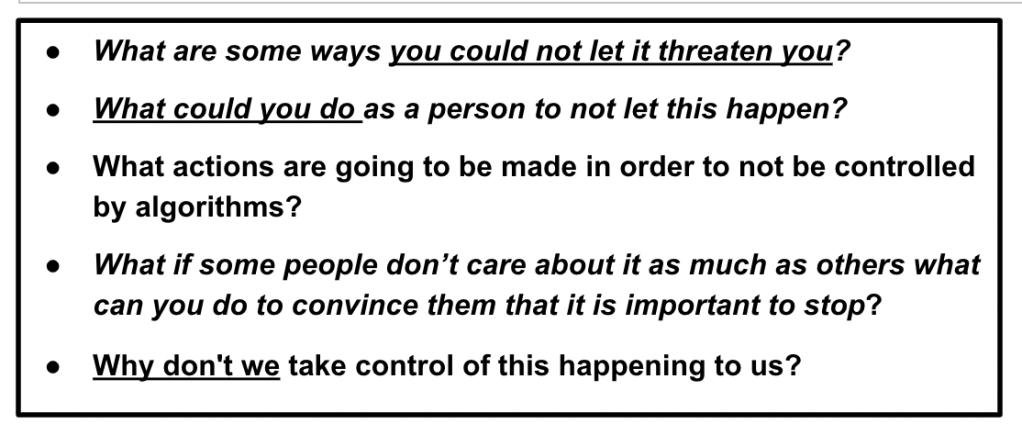
Students pulled apart and interrogated the debate prompt:

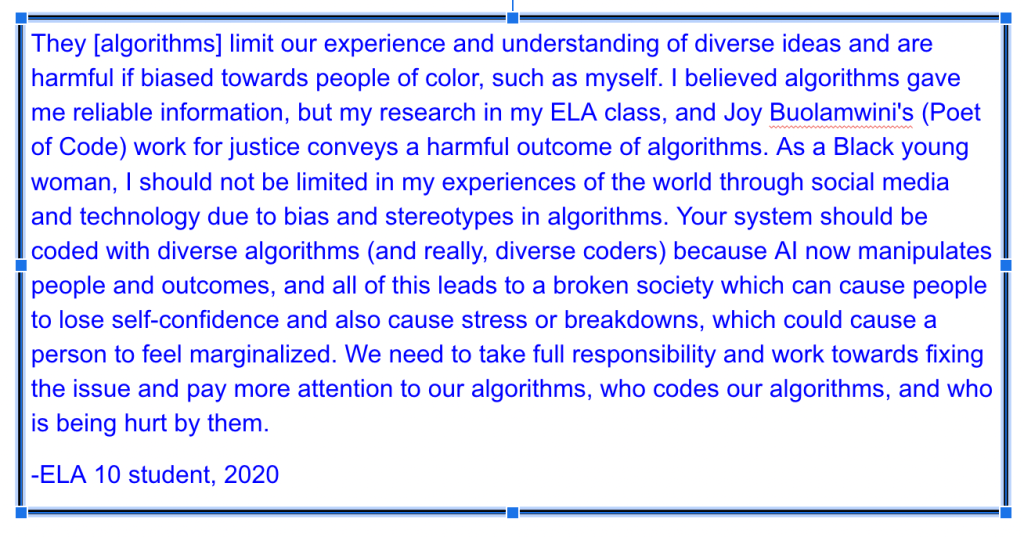
Another student wrote an email to Apple (excerpted below) for her advocacy writing, one of the steps in our Algorithmic Justice mini unit.

The catalyst for my change as a teacher–honoring the obligation and opportunity in each teaching moment–was hitting that Zoomlife wall of disengagement and pushing myself to question alternatives to what I had done before. The topic of Algorithmic Bias/Justice was a game changer for my students as it brought out their authentic questioning, as they grappled with concepts they had never encountered, and pushed each other by using evidence in debate. And, they got to know Joy Buolamwini, The Poet of Code, realizing that such a title and purpose exists.

I created the four-day mini unit and debate at a time when I new something had to change but had little time to make that change happen. It’s a starting point to understanding AI Justice and provided space for students to engage around a topic that they are still talking about two years later.

What now?

This December 20, 2022 Twitter post from The Algorithmic Justice League (@AJLUnited) calling for equitable

and accountable AI caught my attention just this week. What can I do as an English teacher to give space for AI justice in my classroom? I can’t help but admit that I missed an opportunity — am missing an opportunity as I write this– to do better with AI justice through action research writing, and further, through cross-curricular project-based learning. I can say that it is because my school does not have resources (time, staff, school design) to do cross-curricular work, or to take a side-step from mandated curriculum and testing to give students the chance to explore this issue. But, then, I reflect the obligation and opportunity on my part. The question I am grappling with for myself is: How can I break that proverbial wall and do this work in my classroom at a deeper level beyond what I could do/did on Zoom…with or without resources to support that work?

But, here’s the missed opportunity, and one that I hope to build in the future:

What if we were able to break the walls between disciplines and align ELA, Math, Science, Art, Business, and History to engage students in action research and problem solving through design challenges? Importantly, teachers need to have time and space to plan for cross-curricular impact. As I think about full circles (2020-2023) and reflect on how far my students have come in two years despite Zoom, I also think about my role as an educator to not just “Keep it Moving” but to stop and honor the obligation and opportunity to make learning about AI Justice a thing we do. The “wall” will always be there for an under-resourced school like mine, but so will that intentional teacher choice to do something different for students who deserve to know they can be a Poet of Code if they want to be.

#AIJustice #AIHarm #AIBias #ELATeacher #ActionLearning

How My ESL 3 & 4 Students Revised My Thinking on Teaching Debate

It was a real debate. It had an order that established expectations, but it was messy because it was real. Students believed in the process and their own part in owning that process.

Sometimes, it’s good to scrap those painstaking plans and give in to your students’ requests for “but please–just one more day!”

My ESL 4 students  were making their case for extending our final assessment to “just one more day.” I had planned for two hours of a debate, including everything from opening statements that were carefully pre-written in legal teams and practiced like a formal speech prior to debate day, cross examination sessions, team meetings, time-outs for researching additional evidence, and closing statements.Screen Shot 2022-12-29 at 11.56.51 AM

I started in-class debates when working with The Boston Debate League in my 10th grade ELA class and have tweaked the format over the years to extend the cognitive demand in different areas. Debates are dramatic play with students fully bought-in as they take on roles of Pro and Con or Defense and Prosecution.

This past year I adapted the debate structure I’d used in my ELA classes with a debate arguing for or against raising the minimum wage. Where I had always used debate as summative assessments of literature, this debate called on using informational texts and data the way my ELA debates used literary text as evidence. This adaption required skills in reading and synthesizing informational texts and also the agility to flip perspectives quickly in a debate to understand the argument “inside out” to develop counter arguments during the cross-examinations.

I spend a lot of time explicitly teaching questioning to further develop reasoning of an argument…and, to do this using text. This takes practice in many forms across discourse, reading, and writing. So when my ESL3 and 4 students pleaded for “just one more day” of debate, I did not hesitate to change my plan. This was a rich assessment: embedded in the curriculum, it was based on a sequence of formative assessments and aligned to standards. It reflected a clear Focus Language Goal and demonstrated growth in knowledge and skills. It required collaborative reading, writing, and thinking using complex text. Students had to listen carefully to each other, synthesize information, and redirect thinking in-the-moment.

The best part: It didn’t feel like a test. It was a real debate. It had an order that established expectations, but it was messy because it was real. Students believed in the process and their own part in owning that process. This, in my mind, is student-centered learning because it’s managed and enacted by students. Students push one another for evidence–they are choosing to not only engage as students taking an assessment but as decision-makers in a learning experience.

This is just one page from the Debate Packet that provides an organized space for students to record their attack questions (we attack with questions only). In my ELA 10 and AP Language classes students no longer require the scaffolding of “pause + think + talk + write” in order to craft attack questions and respond to opponents’ questions. This is a great scaffold to get students to the point of extemporaneously attacking and defending as a team. You can check out the full Debate Packet here. Screen Shot 2022-12-29 at 11.22.54 AM

What worked really well was dividing the Closing Statement into four questioning segments to get students to really think through their final points. In a collaborative “huddle” students talked and wrote through their closing statement while practicing a concession (#1 below) as well as recalling their strongest evidence. This Closing Statement organizer empowered students to stand before our judging panel and read aloud their planned writing.