
I spent the last two years thinking about how to embed opportunities for students to practice and engage in metacognitive thinking. I think a lot about my students’ levels of awareness of agency and how that relates to their self-efficacy as learners. There is a gap between agency, efficacy, and overall empowerment for many of my students. It’s my job to close that gap by creating more opportunities for engagement with learning. One of the ways I am exploring engagement is by building students’ opportunities for students to practice resilience as learners both in and outside of academic settings. I realized that I need to provide explicit instruction of these social emotional learning skills in order to strengthen my students’ academic wellbeing, so that functioning–and achieving–in an academic setting becomes an internalized part of their self-identity.
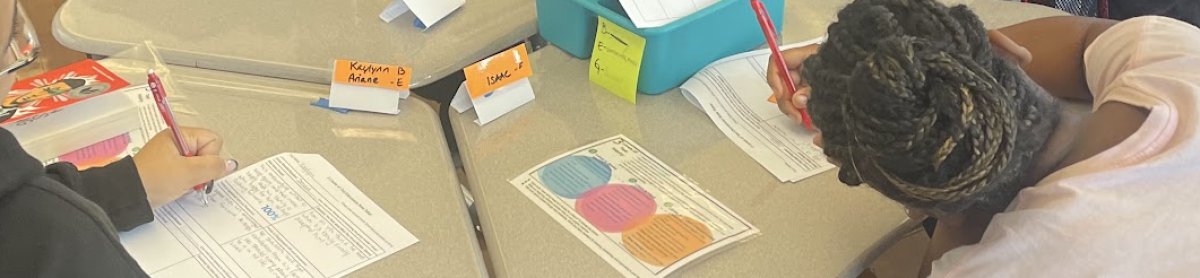
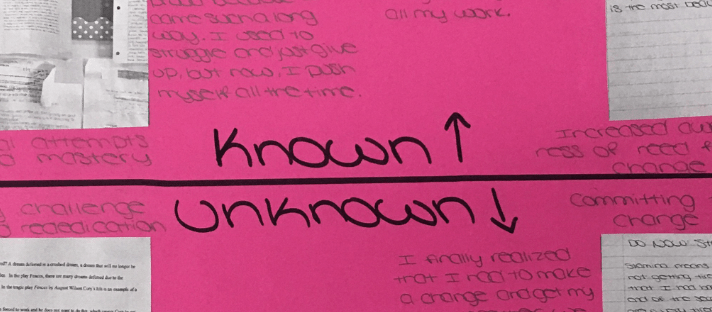
One of the ways I connected metacognitive skill building to academic skill building was through an activity I named, “The Journey Wheel.” My students applied their knowledge of Odysseus’ journey as an epic hero in The Odyssey, along with Joseph Campbell’s Hero’s Journey paradigm, to their own journey through tenth grade English as thinkers, researchers, readers, and writers. As a culminating, end-of-year activity, students utilized their writing portfolios, journals filled with Do Now’s, and evidence of their thinking from debates and trials to document their own growth and resilience in tenth-grade English. Similar to the epic hero paradigm, students traced their journey from the “known” (where they were at the beginning) to the “unknown” (where they pushed through beyond their comfort zones), and finally, back into the “known” (where they arrived back where they started, but with a new mindset)–knowing more after experiencing more.
A student shares her moments of “big change” and “new realizations” as part of her Journey Wheel.
Continue reading “Metacognition as a Path to Inquiry Beyond the Classroom”
 180newbeginnings.com