Writing and the Re-visioning of Failure

With a growth mindset, failure is a right of passage. But for students who supposedly “don’t do school,” that right of passage feels like a set-up. Productive failure, by design, creates opportunities for failure. The persistent redirection, “You’re not done, let’s figure it out,” is an acknowledgement of a student’s humanity, offering the space to grow.

The promise of productive failure in an English Language Arts classroom.

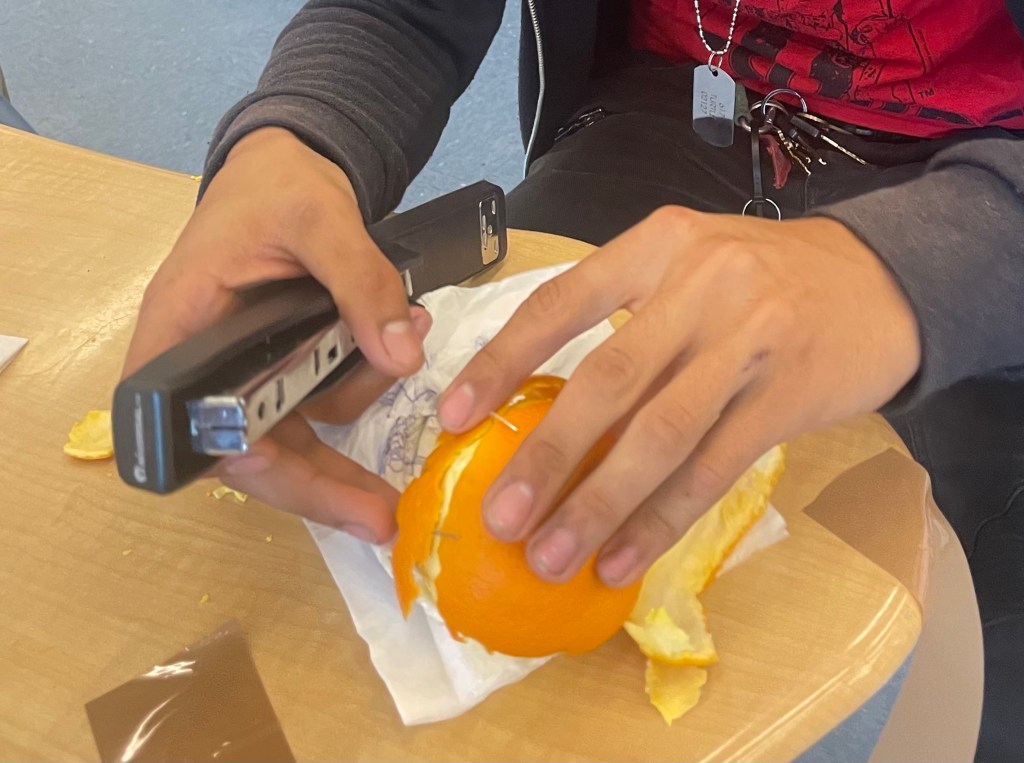
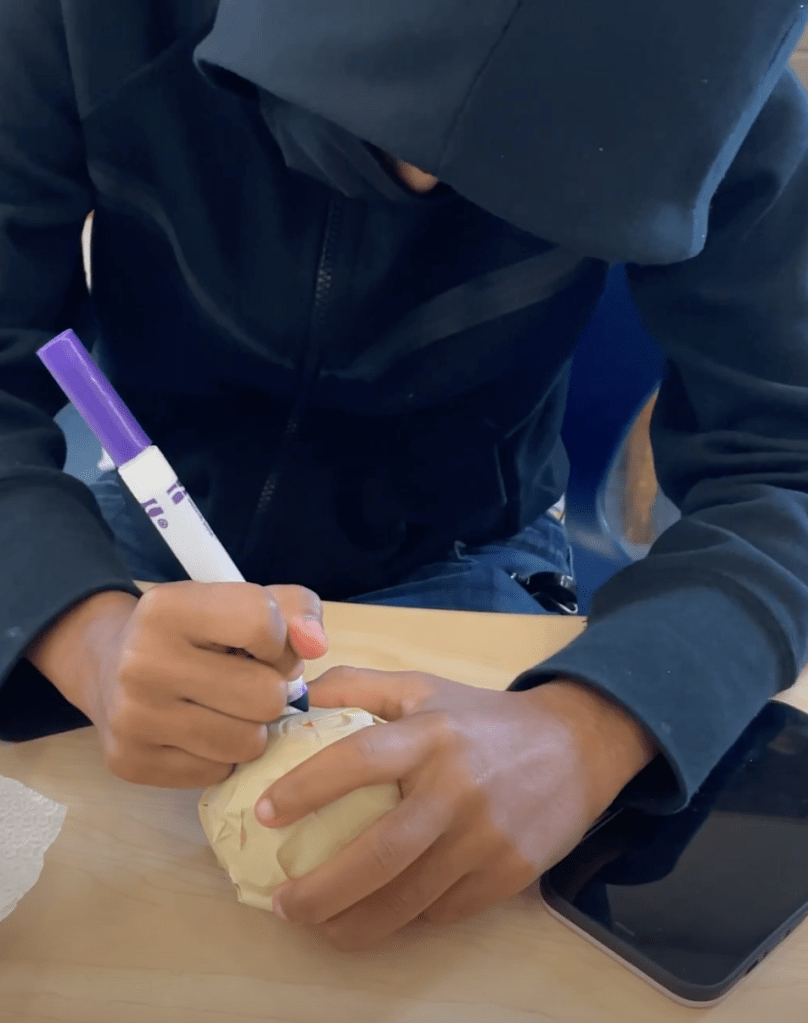
On the first day of summer school last July, I handed each student an orange with the instructions to peel it…very slowly. Some students asked why. Others started immediately. I heard talking as they peeled and laughing when someone asked, “Can I eat the orange?” After everyone was finished peeling, I said, “Okay, now, put it back together.” Inevitably, there were a lot more “Why’s,” and they were a lot louder. I heard a version of “Are you kidding me?” I held firm. “You can do it. This is your only job at this moment. Figure it out.” I walked to each table with a 4-foot long strip of tape for each student.

When I heard students say, “This won’t work!” I questioned, “How do you know?” 

I teach the orange lesson as a metaphor for pushing boundaries, taking risks in learning, and building resilience with the idea of understanding something that pushes against our comfort levels of what [we think we know] we can do. We know what peeling an orange feels like, and we know the outcome of that action. We don’t know—or yet understand—the process of putting an orange back together again. That unknown act requires trust that the process will yield a certain outcome. It also requires vulnerability for playing our part in that process. 

Last July, for the thirty students in front of me who had failed English multiple times over multiple years, I framed it as “unlearning” in the sense that sometimes we must “undo” what we know to move forward and take on new challenges. I asked my students, “Why might unlearning be something we want to try when working with something challenging?” One student raised his hand, “You can’t ‘unlearn.’ You can re-learn, but once you know something, you can never not know it.” I wanted to jump up and down. If there had been any hesitation at spending July and August in a classroom without windows, I could not remember it at that moment. 

I learned valuable information about my students as I observed how they put their orange back together.

In the growth mindset Ted Talks I play for students, there is an explicit message: Fail first; fail often.

With a growth mindset, failure is a right of passage. However, the longer I teach writing to students who supposedly “don’t do school,” the more I recognize that writing is about students giving themselves permission to fail. Each day with my students I see how even the thought of failure stops writing before it starts. In order to assume that “failure” is a conduit of creating and composing, we need to believe that we will recover from failure, and further, that we will be protected from the aftermath of having failed. For some students, failure is a right of passage that feels like a set-up. From a restorative teaching lens, failure is an option that students are less likely to choose if compassion is less visible in their learning environments both in and out of school.

When we teach writing with a restorative lens, as a way to change student mindset, we affirm for students that they are worthy of failure as a means of growth.

I’ve struggled with ways to integrate trauma-informed teaching and restorative practice into my daily lessons until I experimented with ways to integrate that mindset into the teaching of writing. Teaching writing is reliant on a learning environment, rich in affirmation, that prioritizes relationships as a driver of teaching and learning. As Zaretta Hammond points out in Culturally Relevant Teaching and the Brain, this relational piece is what gets students to jump into the work of learning, right into the learning pit. Teaching writing has the effect of revising how our brains are wired, shaping a different way of thinking through learning challenges and productive struggle. Teaching writing is restorative practice.

In that same summer school classroom, I was reminded of how writing is a change-agent, re-visioning how students think about themselves as contributors to the world. One student in particular defied the stereotype of being labeled a failure, learning that he is, in fact, a writer. He wrote a 30-page memoir over four weeks as credit recovery for failing sophomore English.

But first he needed to realize the relevance of writing his story, and I needed to convince him to show up to summer school every single day.

“You should write a book.” 

“Why would I do that?”

“So people can see what you see.”

We closed the deal with my offer: “If you write your book, you’ll earn passing credit for ELA. All you have to do is show up and write.”

His response: “F- it. Let’s do it.”

Every day I am driven by the question of how to engage students who are stuck in a cycle of failure.

Most of my students have failed, multiple times over multiple years, and are labeled by nearly everyone around them as failures. They carry around with them the long list of people who have told them something like, “I’m done with you. I can’t do anything to help you anymore.” The collegial advice I dread is the notion that “sometimes the kid just has to hit rock bottom, and that’s the best thing for them.” At what point does this also mean giving up on a student? Failure is a missed opportunity when we ignore it, or worse, ignore the students who have failed. When we don’t talk about failure, students get stuck and teachers get frustrated, observing engagement move from ritual compliance to, well, nothing. 

As a teacher, I needed to learn to work with failure, not against it.

I began the work of facilitating memoir writing with my student and dug into Manu Kapur’s idea of productive failure, productive struggle 2.0: Set up the problem and step back. Thinking about Kapur’s notion of productive failure, I reframed instructional strategies to create opportunities for failure in my lessons. Here’s how I see this play out in my classroom:  If I’ve set up learning with productive struggle in mind, I’ve already hit the trifecta of rigor, cognitive demand, and student-centered learning. Productive failure is that intentional instructional shift that starts before the student begins. In lesson design, productive failure requires letting go of the “plan” to get the student from A to B by C and allows the student space to problem solve with re-directions rather than directions. 

There’s a voice in my head that still questions the risk of failure by design. Edutopia’s September 2022 interview with Kapur, If You’re Not Failing, You’re Not Learning, affirmed the practice of designing for failure, indicating quantifiable gains in learning outcomes. Similarly, in the Jenny Anderson’s New York Times article Learning the Right Way to Struggle, productive struggle is paired with Kapur’s research on productive failure, where problem solving before learning how to do something produced learning outcomes that changed the brain.

Although mostly associated with STEM, productive failure is exactly the work of writing as there is no way to fully understand how to write until you go through the motions of writing.

There is no ready-made, visible path. Yes, there are graphic organizers and stems and brainstorming and think-alouds, but there’s no guarantee of the end product exactly as it will be written. For my student writing his memoir, the  productive failure was inherent in the act of composing and figuring out: How do I get what is already living inside my head, from my head to my hands, to the page, and to keep that momentum going to compose a story? The path of productive failure is circuitous; it leaves ambiguity within a void of either nothing (denial and quitting) or something new (embracing opportunity). 

I pushed my student to provide more detail, which became one point of productive struggle within a process of productive failure.

Over July and August my student began the work of writing as problem solving, moving forward without knowing what is ahead. But, first he needed to show up. He asked for a morning text to help get him to school, and I followed up every day with a positive note.

During revision I asked questions:

“Why do you think that happened? What were you expecting instead? How do you think things would be different if…” My questions, “What does it sound like? What do you see around you?”

“How do you know it’s X and not Y?” marked a frustration point to which he responded, “This is making me tight. I’m not doing that. It’s just clear in my head.” And I countered, “But it’s in your head, not mine, so you have to make me believe it.” At each point my student stopped with, “This isn’t going to work. I can’t do this.” I responded, “You’re already doing this. Keep going.”

It took a month of writing every day for him to realize that writing the vignettes of his life—and making them stick with the reader through vivid imagery, dialogue, and detail—was a wall that he broke through to get to the other side of what he thought he was capable of before he started. But each break-through moment was matched by a moment of giving up as he said things like, “Why are you helping me? I don’t deserve this. Everyone says I’m a piece of shit.” I sat with that without saying anything so he could be heard. I saw people, educators, treat him just the way he saw himself in that moment of meeting his frustration level. At that moment he knew exactly how to quit. Most of my students choose quitting over failing; quitting prevents them from even starting, making quitting their safety net.

My student met his frustration level because he didn’t have the road map in front of him to tell him how to get the thoughts in his head to the page.

Meeting and naming his frustration was the part of the writing process that proved to him that he could persist. So his response, “This is making me tight,” is met with: “Describe what you are feeling” or “What do you need right now to push through?” or “Tell me why,before I asked “What is your next step?” or “Okay, so that didn’t work. What can you try instead?” My strategy was for my student to be able to name the frustration, acknowledge how it impacts his writing, and move beyond it. When I teach writing, I am upfront with students that the urge to quit is real; it is normal, and it is always present as an option, but our job is to choose another way. 

In the relational work of teaching, and teaching writing in particular, the “Why are you helping me?” or “Leave me alone” moments make me realize the gravity of teaching and the importance of students re-visioning themselves through the act of telling their stories. With my student who was writing his book, I worked to redirect the “quitting before failing” learning pattern, so that he could learn to push through the productive failure and change his response to his frustration level. 

Teaching is coaching in a learning environment that lifts up productive failure.

Coaches don’t assume their players will fail. They push them to get better, but they don’t say, “yeah, I’m done with you.” There’s a contract or understanding based on the value of the player. As a teacher, I am constantly reframing from that same coaching perspective—always keeping the asset-based mindset. Failing forward is a choice, both on my part as the teacher and the part of my students. And no one is going to fail without a safety net. Building students’ metacognitive skills within a restorative approach helps students to understand how to use failure and increases learning outcomes. The persistent redirection of “No, You’re not done; there’s more to do; let’s figure it out” is an acknowledgement of a student’s humanity, offering the space to grow. This restorative redirection is also an acknowledgement of the high rigor and standards we believe a student will meet.

On the twentieth day of my student’s writing I printed 30 pages and bound it with a large clip. When I showed him, he stared at the cover page without saying anything, then slowly flipped through each chapter. “I did this?,” he asked. And then he sat down with a pencil in hand and started to read his own story.

Three months after summer school, I presented at our school’s summer training for staff. I asked my student if I could share a paragraph of his memoir with the staff to help people understand firsthand a student’s self-perception as a result of experiencing persistent failure in school. The last slide of the training was just one paragraph of my student’s writing. I presented it as a reflection moment. Soon after, another adult asked to read his memoir. And then another. From time to time my student will text, asking for a book title or sharing and idea for a story. Being a part of this process is transformative.

I am experimenting with how to facilitate failure so that it holds new meaning in the learning process. When the student hits a wall and quits, I now resist the temptation to help or guide as readily as I have in the past. I push with a restorative lens, providing consistency and unconditional promise that students are not yet finished with a learning process that requires them to dig in and find their own way through. That is the meaning I have made with “productive failure.” It’s a mindset shift for me as a teacher, one that I learned from teaching students who “didn’t write” and “didn’t read”…until they did.

How Teaching AI Bias Exposed Obligation & Opportunity in My Lessons

The lessons I taught in the “before times” lost relevance and impact in 2020 Zoomlife. I had to do it differently. Something clicked for me when I listened to Manoush Zomorodi’s interview with Joy Buolamwini on NPR’s Ted Radio Hour. And this question (also the segment’s title): How Do Biased Algorithms Damage Marginalized Communities? opened a door to a new opportunity. Algorithmic Bias. I asked my students the next day, “What do you think of when you hear ‘Algorithmic Bias'”? And this time, my students’ silence was a signal to me to ask differently.

Two years ago, and two months into the start of another year of Zoom learning, like many of us teacher folk, I hit a wall. I had only heard six students speak. I didn’t know what my students looked like apart from the avatar on a blank screen. While this isn’t unique to my teaching journey in Zoomland, it is the catalyst for my personal moment of “Okay, this isn’t working, so now what?”

Zoom or no Zoom, my school’s instructional focus still called for instructional dialogue in every class. Certainly a full believer in instructional dialogue, I still struggled to replicate the practice on Zoom. The feedback I received after my evaluator observed an AP Language Zoom lesson was to work on leveraging more student voice. I didn’t see how that was possible on Zoom at that time, but I would understand it months later when I took the leap into digital debates. My mind could not digest the act of “doing a debate” on Zoom–especially when students were not talking either in breakout rooms or in whole-class “discussions.” I knew how to do in-person debates, but the alternative felt impossible.

Here’s how it went down

“C’mon just say something.” (YES! Someone unmuted! I’m literally clapping.)

Then, in the chat: “Cloudy. Cloudy. Cloudy. Stormy. Cloudy. Hurricane. Yeah, pretty windy here. IDK, TBH IDC. Maybe sunny?

I don’t think I was the lone teacher who started Zoom class with the question, “What’s your weather (mood/feeling) today?”–a faux “circle” opener as social-emotional check-in. I held tight to the belief that ritual and routine helped students normalize the Zoom classroom.

So I was facing this wall of “So, now what?” and could not turn away from that pokey question. I felt the urgency to design lessons that held a deeper meaning and that matched the importance of our critical consciousness emergent of the Twin Pandemics: Racial reckoning + Covid. I felt passionately about the urgency required within my capacity as a teacher to do something with whatever tools I had to teach with at that time. I remember sitting in my kitchen, my dog panting next to me, staring at the Zoom screen with blank squares, and saying something like this (what I thought to myself every single day of teaching with my dog from my kitchen):

“This is the time. You are living this moment for the first time. We all are. Your experiences right now will be read and talked about by your grandchildren. We have never been here before.”

I went on for too long. Or, maybe not…I had no social cues to read. But I said this repeatedly with different words on different days. I felt it in my core. This time was an opportunity; no, not opportunity, obligation. I either choose to engage in this moment as an educator or keep it moving (in the other direction…backwards).

Making a choice is taking a stance in every lesson

I chose (and will always choose) the obligation=opportunity route. But my passion, intention, and sheer will were not producing results. Students were not just disengaged, I’m not sure they were actually present. (Side note: Fast-forward two years, and my Zoom 10th graders are now my seniors. They laugh about the Zoom Year and how much freedom they had to disengage if they chose to mute and sleep or mute and FaceTime or mute and…[fill in the blank].)

But then…Algorithmic Bias, Justice & The Poet of Code

The lessons I taught in the “before times” lost relevance and impact in 2020 Zoomlife. I had to do it differently. Something clicked for me when I listened to Manoush Zomorodi’s interview with Joy Buolamwini on NPR’s Ted Radio Hour. And this question (also the segment’s title): How Do Biased Algorithms Damage Marginalized Communities? opened a door to a new opportunity. Algorithmic Bias. I asked my students the next day, “What do you think of when you hear ‘Algorithmic Bias'”? And this time, their silence was a signal to me to ask differently. So I asked it like this instead: “What if you heard those two words apart from each other, like ‘Where have you heard the word algorithm before?’ and ‘Where have you heard the word bias?'” Their responses back to me in the chat were more than one-word answers for the first time since we started in September (and it was November). We then had a discussion between chat and actual talking about the impact of putting those two different words together– with two different contextualized meanings –to create a new meaning. This was a big learning moment for me, and I hope for my students.

Obligation & Opportunity in Action

Based on critical consciousness of systemic racism we are obligated as a society to re-contextualize our lived language–in this case the joining of the two words “algorithm” and “bias.” My students had not thought of bias as related to algorithms, but once they listened to Joy Buolamwini’s Ted Talk (How I’m Fighting Bias in Algorithms) and then her interview with Manoush Zamorodi, they not only understood the implications of algorithmic bias but pushed each other in a debate for the need for algorithmic justice. My students’ excitement that there is the option in life to be called a “Poet of Code” was matched by their exposure to Joy Buolamwini’s story: If she can simultaneously fight racism, and fight the algorithms that design and perpetuate an ingrained cultural bias, then so could they.

Through discussion that eventually led to a formal debate (YES, on Zoom!), my students recognized the fight in something so seemingly benign as an algorithm. The irony here was that we were doing this work within and among AI culture. My students (now as seniors who admit that social media became their only social structure in 2020 Zoomland) began to question the flipside to AI and social media in their lives:“Wait, you mean what you see on your ads are not the same as mine?” I shared ads that popped up in my social feed: lipstick for “mature” women and area rugs on Wayfair. They laughed, but then compared the ads they saw and dug deeper to question economic justice behind those ads.

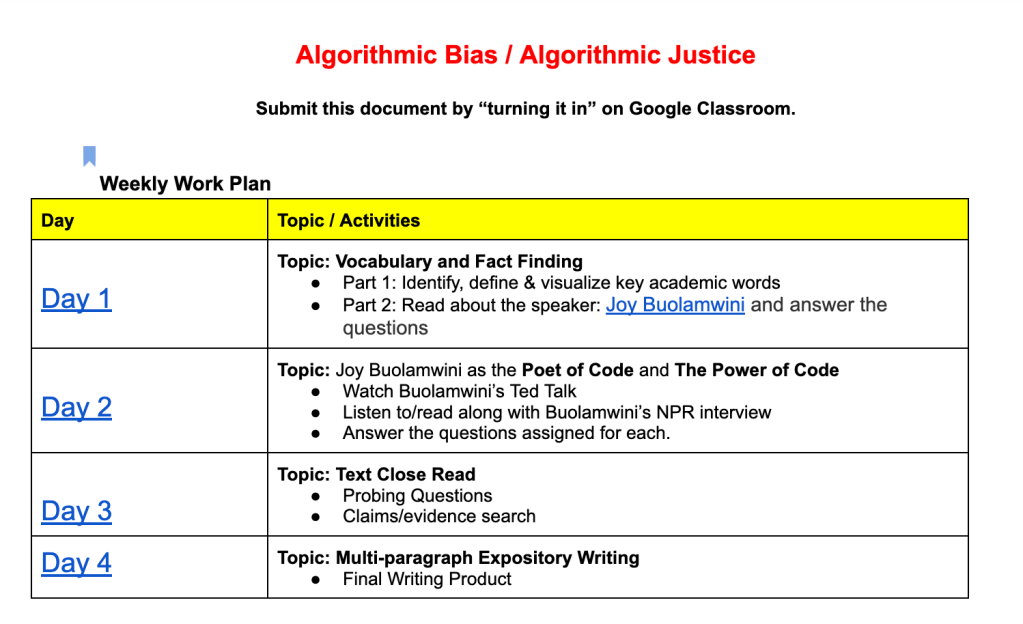
We Zoomed through this AI discovery together. Over a four-day lesson, and then a full debate, my students were ready to write a letter/email/article advocating for Algorithmic Justice. While some writers focused on social media and advertising, the majority of writers shared concern for racial profiling and systemic racism due to algorithmic bias.

One student shared the urgency of algorithmic justice like this:

What we’re experiencing now with bias in how algorithms are being written is like a fire alarm being pulled and no one coming to put the fire out. And the fire is literally burning some people and not others. Who’s going to put this fire out? I’m not sure it can be put out if not everyone sees it burning.

The debate prompt was challenging — a great opportunity for productive struggle through unpacking the prompt, writing about it, and then interrogating it with questions in their debate teams. Students who wanted more of a challenge opted for the “Con” side of this prompt, pushing themselves to argue the opposite of their own opinion, as I reminded them, they will do when they become lawyers. A good reminder that we debate positions, not opinions. (Check out more resources on debate for middle school, high school beginners/English Learners and a sample Debate structure for AP Language).

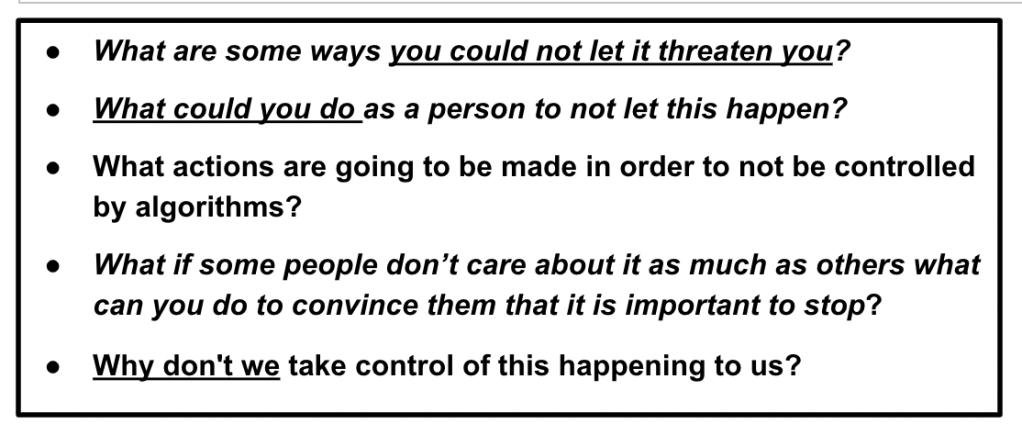
Students pulled apart and interrogated the debate prompt:

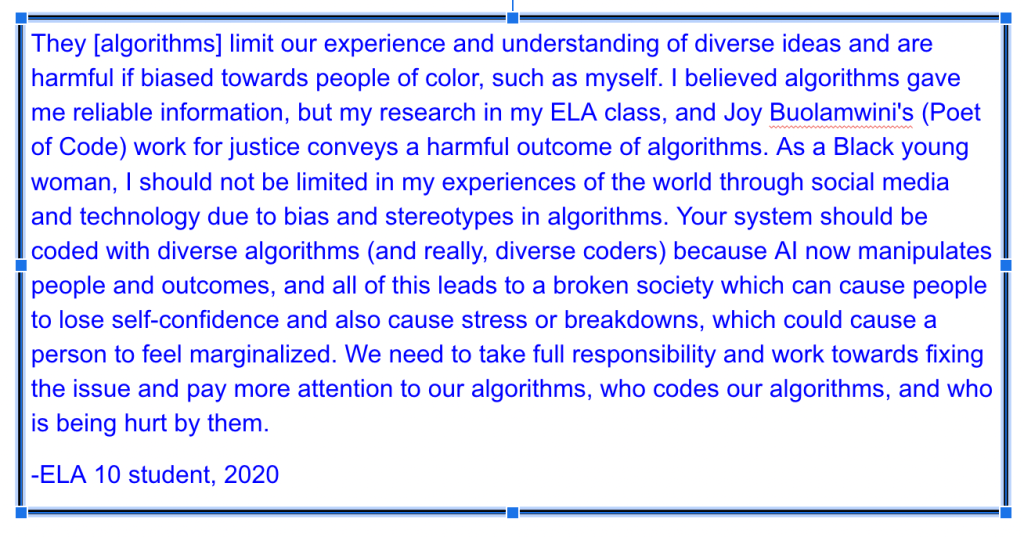
Another student wrote an email to Apple (excerpted below) for her advocacy writing, one of the steps in our Algorithmic Justice mini unit.

The catalyst for my change as a teacher–honoring the obligation and opportunity in each teaching moment–was hitting that Zoomlife wall of disengagement and pushing myself to question alternatives to what I had done before. The topic of Algorithmic Bias/Justice was a game changer for my students as it brought out their authentic questioning, as they grappled with concepts they had never encountered, and pushed each other by using evidence in debate. And, they got to know Joy Buolamwini, The Poet of Code, realizing that such a title and purpose exists.

I created the four-day mini unit and debate at a time when I new something had to change but had little time to make that change happen. It’s a starting point to understanding AI Justice and provided space for students to engage around a topic that they are still talking about two years later.

What now?

This December 20, 2022 Twitter post from The Algorithmic Justice League (@AJLUnited) calling for equitable

and accountable AI caught my attention just this week. What can I do as an English teacher to give space for AI justice in my classroom? I can’t help but admit that I missed an opportunity — am missing an opportunity as I write this– to do better with AI justice through action research writing, and further, through cross-curricular project-based learning. I can say that it is because my school does not have resources (time, staff, school design) to do cross-curricular work, or to take a side-step from mandated curriculum and testing to give students the chance to explore this issue. But, then, I reflect the obligation and opportunity on my part. The question I am grappling with for myself is: How can I break that proverbial wall and do this work in my classroom at a deeper level beyond what I could do/did on Zoom…with or without resources to support that work?

But, here’s the missed opportunity, and one that I hope to build in the future:

What if we were able to break the walls between disciplines and align ELA, Math, Science, Art, Business, and History to engage students in action research and problem solving through design challenges? Importantly, teachers need to have time and space to plan for cross-curricular impact. As I think about full circles (2020-2023) and reflect on how far my students have come in two years despite Zoom, I also think about my role as an educator to not just “Keep it Moving” but to stop and honor the obligation and opportunity to make learning about AI Justice a thing we do. The “wall” will always be there for an under-resourced school like mine, but so will that intentional teacher choice to do something different for students who deserve to know they can be a Poet of Code if they want to be.

#AIJustice #AIHarm #AIBias #ELATeacher #ActionLearning

Those Big Feeling Words

Especially this week with the passing of Toni Morrison I am reminded of her vision of “doing language.” Her words, and the way those words go together to create images and emotion, are a testament to how language is living because we “do” it: We construct and deconstruct, we mess with it, we use it in ways that are new and exciting…even if those ways come from the old and expected.

Language is enmeshed with the human experience. It is also our map of lived experience individually and collectively. When I was 12, my mother asked what one book I wanted for my birthday. I asked for Morrison’s book Beloved. I read it every night; I didn’t fully understand or grasp the words or actions in the book at that time, but I did feel deep emotion as I read it and long after. The language did something to my heart before my mind could process those words together. The book was an experience, and it haunted me. It’s a book that stayed with me and pushed me to believe and feel outside of my world.

I think a lot as I write and read and teach writing how to make words into pictures and movies–how can we mess with language to make people feel something beyond themselves? When I teach writing–especially personal writing–I experiment with ways for students to get messy with language. As a teacher, I am inspired by the moments my students are, in Morrison’s words, “doing” language. It’s the moment someone is hearing her voice for the first time through her own words on the page. It’s the moment someone has no words to say when she hears or reads the writing of her peer for the first time. My job as a teacher is to find ways to facilitate those moments for students and to help students see that they have the power and space to make those moments possible again and again.

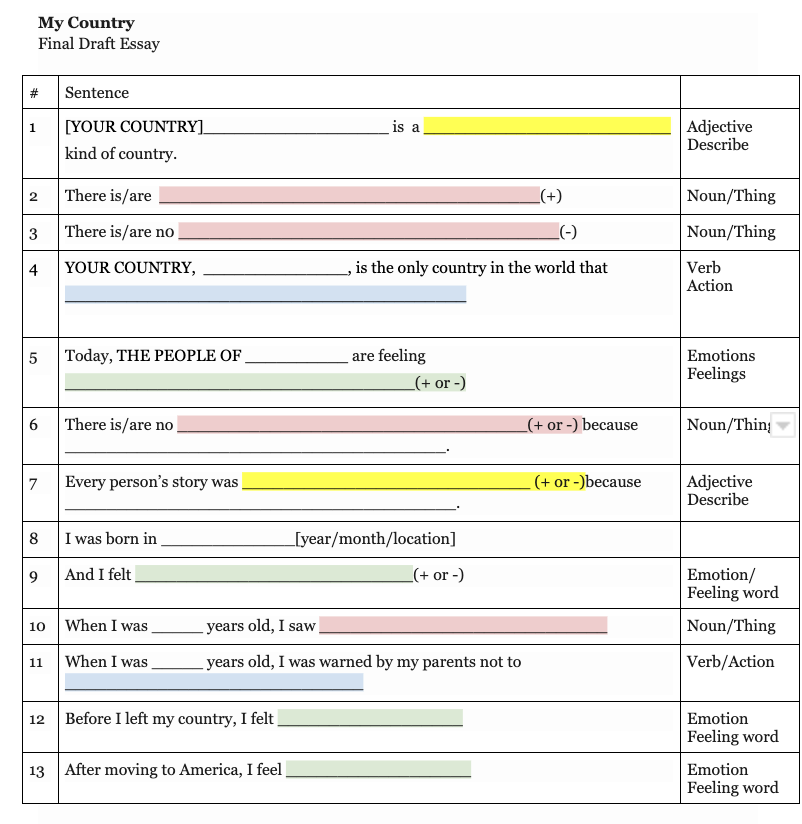
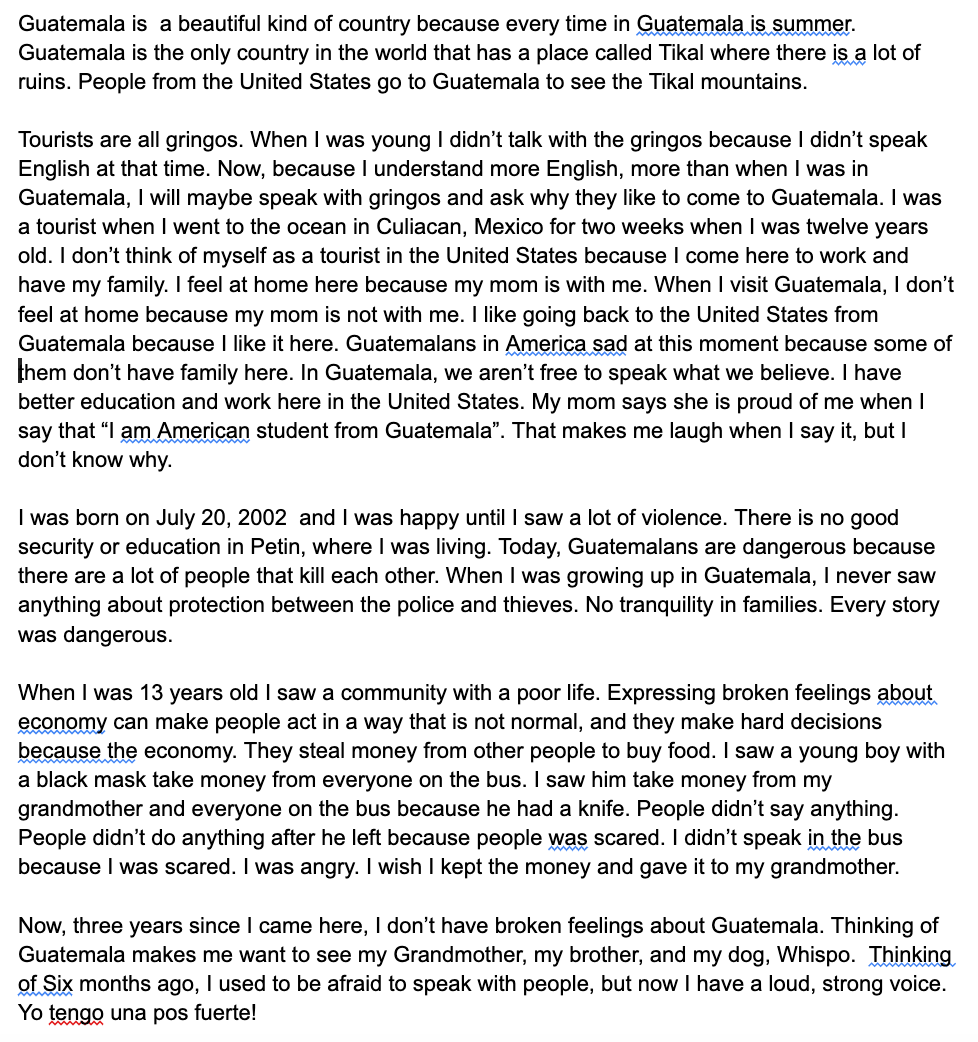
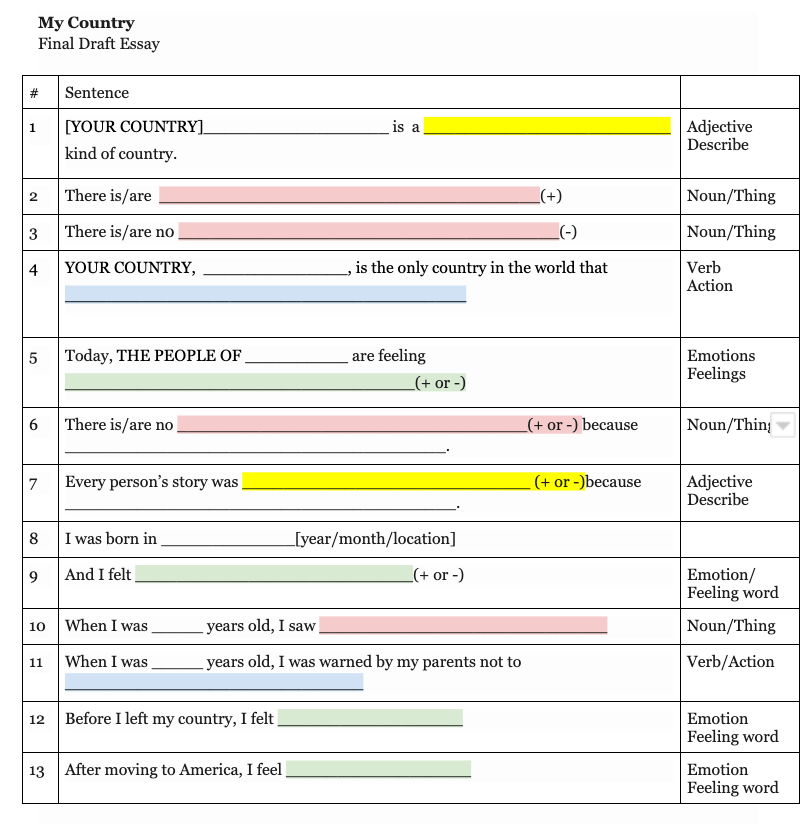
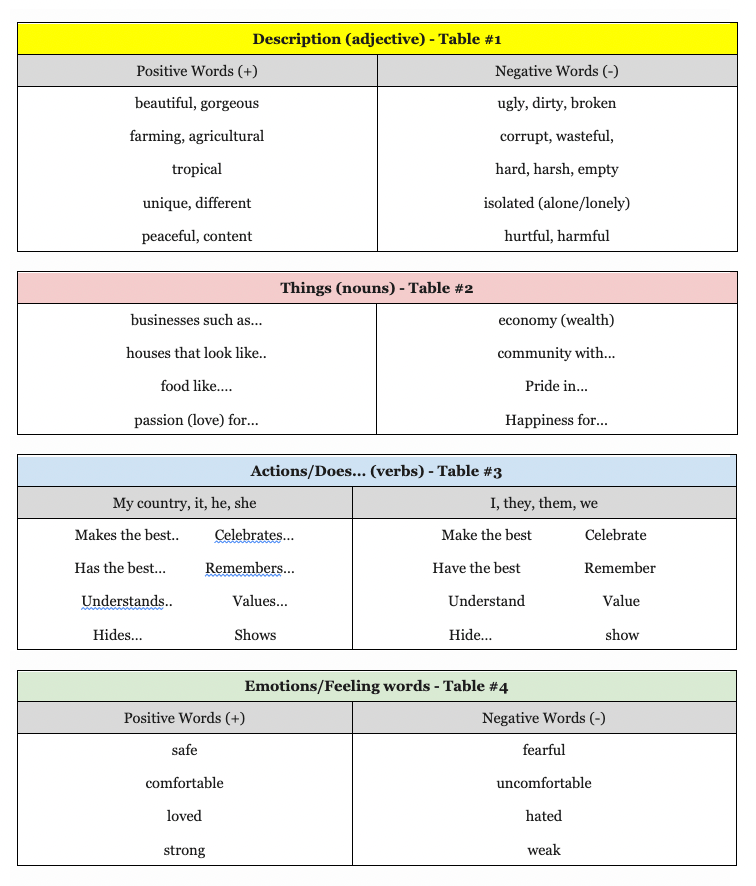
This past year in my ESL 3 class we dug into emotional language as part of personal storytelling. I created and used highly scaffolded storytelling organizers so emergent English speakers could access the power of storytelling. You can check the organizers out here. I didn’t want to just reach emotional language for its functionality as a rhetorical device. I wanted to give space for my students to explore the big ideas and big feelings of words that hold meaning in our lives. The English teacher in me calls these “themes” or thematic words. But they are more personal and emotional than their literary function: These words are the words that stop and start us. They ignite something in you that you maybe cannot define or recognize by sight or name, but that you hold space with. I want to help students recognize in themselves what I did when I first read Morrison’s Beloved.

One student’s personal story, composed using the color-coded organizer above and linked in full below. The arc of the story takes the reader from past to present, and this writer beautifully claims her present and future in her words below.

Owning Language Piece-by-Piece

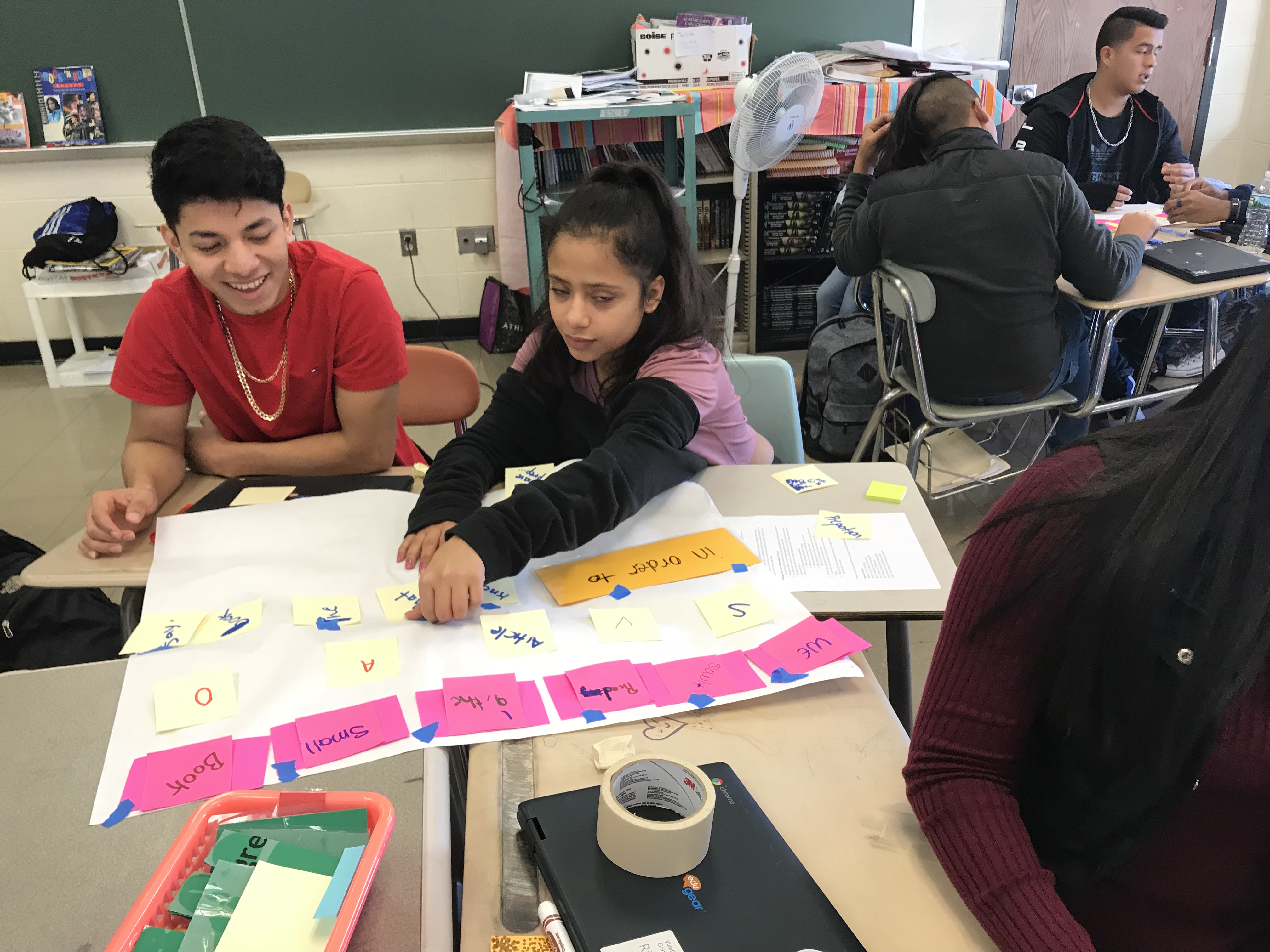
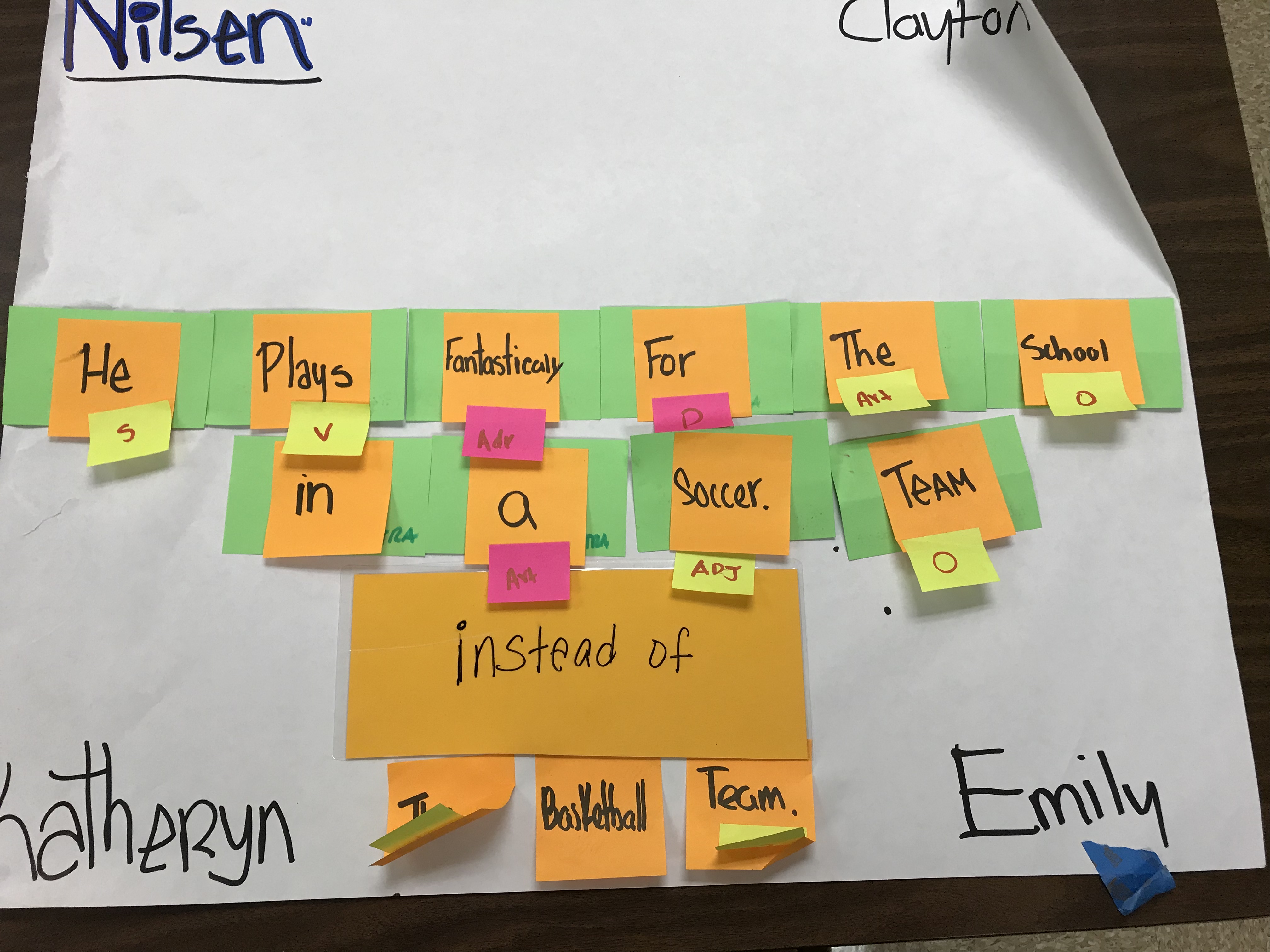
One of my favorite ways to look at the word, phrase, and sentence levels in writing is a Sentence Building or Organizing activity that relies on physical manipulation of language parts. A video of my ESL3 students working with this activity is linked here. These activities facilitate student-centered learning in teams as a way to help students not only dissect sentence parts, but use sentence parts in various ways when building a sentence. I developed this activity as a way to engage students beyond the Chromebook, in teams, and with their “hands.” I wanted students to feel not only like they were in control of language, but that they were empowered to make decisions to build complex sentences with prepositional phrases in different ways. This activity came out of a learning I had from previous lessons where students expressed hesitancy with “playing with language.” I wanted students to feel that they could be decision-makers when writing sentences and that sentence composing is similar to moving around pieces of a game or puzzle. This activity also focused on our unit’s social objective (listening to the speaker, eye contact, and speaking so others can hear you).

Organizing Sentences Activity- This activity was a formative assessment (I called it a group quiz) to our Sentence Building activity. Now that students practiced building sentences and demonstrating self-monitoring and decision-making when sentence composing, I wanted students to become comfortable with sentence complexity within the data unit content by using parts of a complex text (from a scientific article about climate change) to rebuild, or put those pieces together again into a sentence that makes sense coherently and logically. I wanted students to work together, show what they know in terms of sentence parts, sentence combining, and prepositional phrases to compose complex sentences, and also to push each others’ thinking with targeted questions. Each team received a large envelope with the full directions printed here. Each team received a set of cards (also printed here) to help facilitate academic discourse, which, in turn, helped to facilitate students’ language and content development. Each person on the team practiced accountability by taking on a role related specifically to the academic skill of group discussion. Before the activity, we practiced different questions that each role/student would ask in his/her team according to pre-printed discussion cards. The Organizing Sentences Activity directions are linked below. I have also included pictures below. This lesson pushed students to feel what it’s like to solve problems within a group when there is no “right answer” in front of them. As I walked around the room, I questioned students’ choices regarding phrase/word arrangement as they rebuilt their sentence from pieces. “Why did you decide to use that phrase after this word?” “What is your next step in this process?” “What’s another way to say/write this sentence?” “How can you backup your decision?”