Owning Language Piece-by-Piece

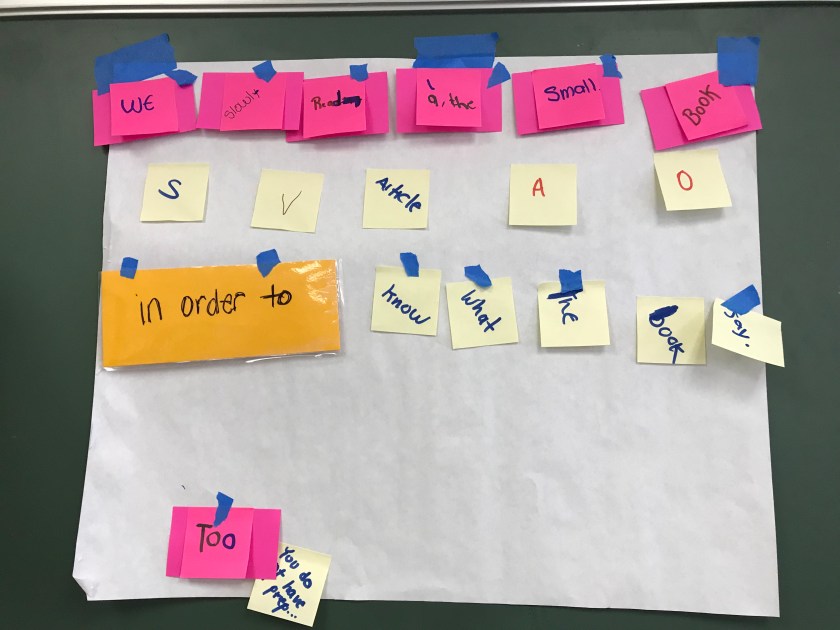
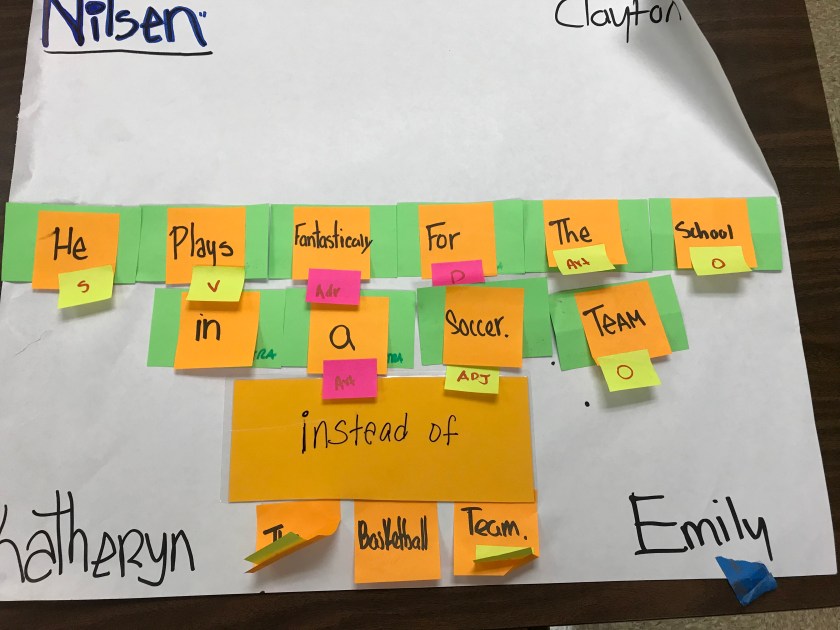
One of my favorite ways to look at the word, phrase, and sentence levels in writing is a Sentence Building or Organizing activity that relies on physical manipulation of language parts. A video of my ESL3 students working with this activity is linked here. These activities facilitate student-centered learning in teams as a way to help students not only dissect sentence parts, but use sentence parts in various ways when building a sentence. I developed this activity as a way to engage students beyond the Chromebook, in teams, and with their “hands.” I wanted students to feel not only like they were in control of language, but that they were empowered to make decisions to build complex sentences with prepositional phrases in different ways. This activity came out of a learning I had from previous lessons where students expressed hesitancy with “playing with language.” I wanted students to feel that they could be decision-makers when writing sentences and that sentence composing is similar to moving around pieces of a game or puzzle. This activity also focused on our unit’s social objective (listening to the speaker, eye contact, and speaking so others can hear you).

Organizing Sentences Activity- This activity was a formative assessment (I called it a group quiz) to our Sentence Building activity. Now that students practiced building sentences and demonstrating self-monitoring and decision-making when sentence composing, I wanted students to become comfortable with sentence complexity within the data unit content by using parts of a complex text (from a scientific article about climate change) to rebuild, or put those pieces together again into a sentence that makes sense coherently and logically. I wanted students to work together, show what they know in terms of sentence parts, sentence combining, and prepositional phrases to compose complex sentences, and also to push each others’ thinking with targeted questions. Each team received a large envelope with the full directions printed here. Each team received a set of cards (also printed here) to help facilitate academic discourse, which, in turn, helped to facilitate students’ language and content development. Each person on the team practiced accountability by taking on a role related specifically to the academic skill of group discussion. Before the activity, we practiced different questions that each role/student would ask in his/her team according to pre-printed discussion cards. The Organizing Sentences Activity directions are linked below. I have also included pictures below. This lesson pushed students to feel what it’s like to solve problems within a group when there is no “right answer” in front of them. As I walked around the room, I questioned students’ choices regarding phrase/word arrangement as they rebuilt their sentence from pieces. “Why did you decide to use that phrase after this word?” “What is your next step in this process?” “What’s another way to say/write this sentence?” “How can you backup your decision?”
Reading MCAS as text

As a teacher of 10th grade ELA, I understand the urgency of six short months. The MCAS, feelings aside, is a reality for classrooms, schools, districts, and above all, students and families. In Boston, MCAS Bootcamps rallied students to attend full school days over February vacation and refocused students on a common goal. Whatever metaphor I use with my students (MCAS is a competition, a video game, a sport, etc.), the test is a literal marker of a student’s access to life beyond high school for college and career. So often, schools that explicitly teach test literacy are shamed (and by test literacy I mean: How a student reads and consumes and negotiates the test with agency and awareness). These are the same schools that are criticized for “teaching to the test.” My goal with this post is by no means to be political, but I do think it’s important in my practice to name opportunities for explicit instruction to empower students, and teaching the literacy of high stakes testing, I believe, not only empowers students as test takers, but as critical thinkers and consumers of information when accessing and achieving the very standards that the MCAS (and SAT, and AP) are assessing.

Big Picture: My job as a teacher is to facilitate student access and achievement, and I want that access and achievement to be standards-based. [But/and], the immediate window of opportunity as a tenth grade teacher is six months from where each student is at when we meet in September.

From where each student is at… So, what can I control? What and how I teach, and how I readjust my teaching with fidelity.

What if I flipped my thinking and didn’t see “teaching to the test” as a be all, end all deficit? Having taught in different types of secondary school settings as well as in higher education programs, I know that test literacy is a crucial skill extending well beyond MCAS. I believe it’s a life skill. It’s a skill in making explicit what is often implicit: cultivating and sustaining self-efficacy and agency in high-stakes situations. Since I began teaching, I’ve experimented with ways to making learning as explicit as possible–not because it makes the work of learning easy, but because it makes the work of learning a transferrable and lifelong skill.

This past fall, I adapted ELA MCAS “boot camp”-style curriculum for English Learners who were retaking the November ELA test. (Day 1 and Day 2 slides of the 5-day session are linked here). I used choice writing frames like this to help make writing tasks on the Legacy MCAS explicit. I realized that I needed to peel away the layers of text inherent in the MCAS to make meaningful words such as “elicit, demonstrate, decipher, explain, reasoning.” Students may understand fully the word “explain,” but what is the success criteria of the word “explain” in a written response versus a reading passage question on MCAS? And, what agency does a student feel when encountering the command “explain” when asked about character change from beginning to end of an excerpt (and what does the word “excerpt” mean to me on this test)?

I think consciously about student agency and implicit bias in many forms, and high-stakes testing in particular. As an ELA and ESL teacher, I try to find ways to teach the layers of text within a test like MCAS. What can I do to facilitate my students’ ability to navigate those many layers of text? That’s a question that pushes me when working with any text. So, I began to change they way I viewed MCAS by teaching the layers of literacy within the test. This year, due to timing, I experimented with virtual sessions on Google Classroom and YouTube. It’s far from a solution, but it is an interesting dilemma to consider, politics of standardized testing aside. As an ESL teacher this past year, I began to unpack the relevance and urgency of demystifying the complex layers of literacy a student needs in order to move between home, school, and work with friends, family members, teachers, lawyers, counselors, bosses, doctors, store clerks, pastors, bus drivers, etc…..the web of literacy we encounter when moving between different worlds defines our levels of interaction and our ability to function in each world. Because of this, I don’t see the explicit teaching of test literacy as “teaching to the test” so much as it is teaching literacy in its many forms, facilitating student agency to become critical consumers to uncover what needs to get done, where, how, and why.

Taking a Stand with ESL3 – Debate in Action + Debate Materials that work

This past spring I got to test out and adapt a Model Curriculum Unit that I co-authored with colleagues as part of a DESE Next Generation ESL FacT Training where we used The Collaboration Tool to design standards-based units. DESE’s Next Generation ESL FacT  training provided invaluable learning with colleagues across the Boston area, supporting facilitation of the Model Curriculum Unit curriculum design framework. In this video, I engage ESL3 students in a mini lesson about point of view and protest speech. Students used transfer knowledge from our previous unit in argumentation to help solidify how rhetoric and point of view are related in speech writing. 

The Model Curriculum Unit I designed, The Language of Debate, pushed my students to become debaters of minimum wage. All of my students work as essential workers (roofers, restaurant servers, dishwashers, grocery store employees) and this debate allowed the space for seeing more than one side of the minimum wage issue. When one student shared that he was a coffee picker in his home country–just one year prior–the class understood the road to earning an hourly wage and the security that comes with that right. This debate on minimum wage was more than an assignment; it provided access to evidence and tools to craft an argument for advocacy. This debate empowered students to understand how to take a stand with language and to use their lived experiences as fuel for a compelling position. 

I knew my students could handle a debate while practicing speaking, listening, reading, and writing a new language, but I also know that a well-run debate with high expectations contains many components and relies on everyone understanding all parts. I developed this visual cue resource to help students visualize the steps in a debate structure. While it may seem simple in design, students had it in hand to remind them of their role and timing during debate. I laminated copies for each student as part of their debate packet.

Screen Shot 2022-12-29 at 10.57.55 AM

The closing statement essay organizer, below, provided visual cues to scaffold the writing process and produce a final summation of their position to the judges. Each question in the green-shaded column was crucial in getting students to not only jump-start, but to extend their writing.Screen Shot 2022-12-29 at 11.01.42 AM

I have since shared my debate materials with teachers ranging from middle school to high school. I’ve adapted the materials to the age and levels of my students, but I continue to return to the necessity of clarity when creating debate material for students. Check out my debate materials plus more debate goodies here.

Metacognition as a Path to Inquiry Beyond the Classroom

I spent the last two years thinking about how to embed opportunities for students to practice and engage in metacognitive thinking. I think a lot about my students’ levels of awareness of agency and how that relates to their self-efficacy as learners. There is a gap between agency, efficacy, and overall empowerment for many of my students. It’s my job to close that gap by creating more opportunities for engagement with learning. One of the ways I am exploring engagement is by building students’ opportunities for students to practice resilience as learners both in and outside of academic settings. I realized that I need to provide explicit instruction of these social emotional learning skills in order to strengthen my students’ academic wellbeing, so that functioning–and achieving–in an academic setting becomes an internalized part of their self-identity.

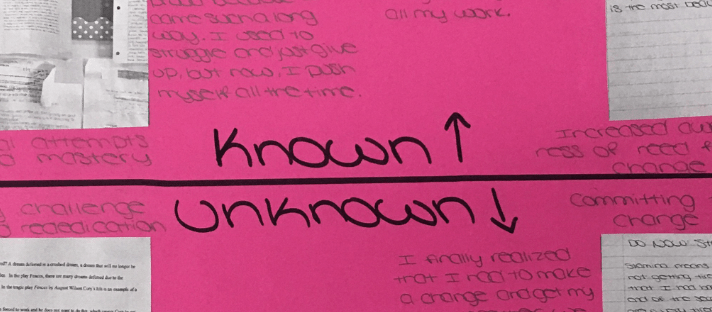
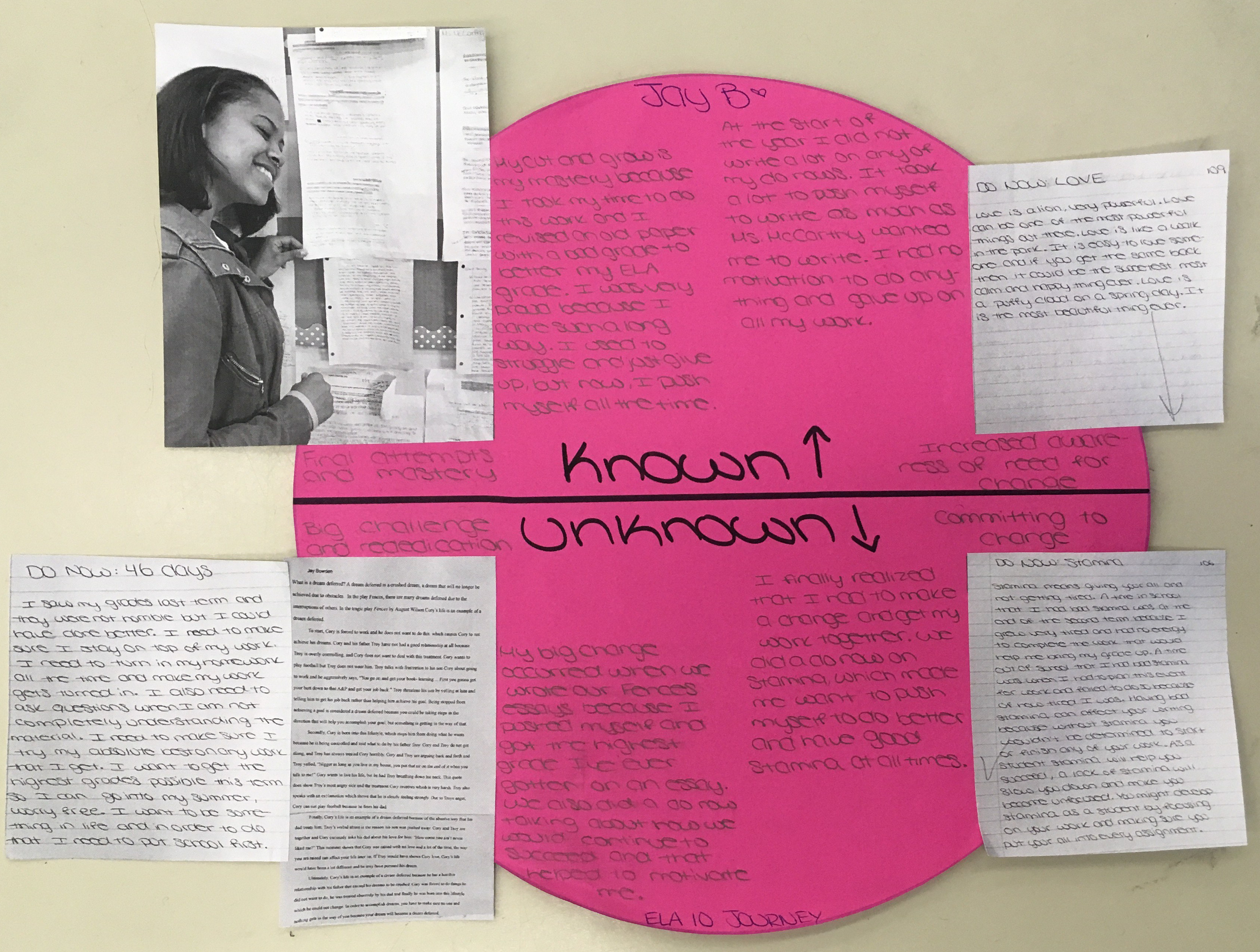
One of the ways I connected metacognitive skill building to academic skill building was through an activity I named, “The Journey Wheel.” My students applied their knowledge of Odysseus’ journey as an epic hero in The Odyssey, along with Joseph Campbell’s Hero’s Journey paradigm, to their own journey through tenth grade English as thinkers, researchers, readers, and writers. As a culminating, end-of-year activity, students utilized their writing portfolios, journals filled with Do Now’s, and evidence of their thinking from debates and trials to document their own growth and resilience in tenth-grade English. Similar to the epic hero paradigm, students traced their journey from the “known” (where they were at the beginning) to the “unknown” (where they pushed through beyond their comfort zones), and finally, back into the “known” (where they arrived back where they started, but with a new mindset)–knowing more after experiencing more.

A student shares her moments of “big change” and “new realizations” as part of her Journey Wheel.

Journey wheel jay Continue reading “Metacognition as a Path to Inquiry Beyond the Classroom”