

This summer I participated in the district’s Social Emotional Academic Integration curriculum development cohort. I served as Point of Contact for the ELA/ESL cohort, facilitating meetings with colleagues across the district to develop strategies for integrating social emotional learning into the academic curriculum through both explicit lessons and lessons where social emotional skills are embedded seamlessly into the curriculum. As part of this curriculum development cohort, my job was to design a curriculum map for the year (Curriculum Map for ELA 12 (College English 12) SY2018-2019) as well as four lessons that incorporated social emotional learning standards aligned to state standards. While I have always approached lesson planning as facilitating events and experiences for students, the district’s “Learning Experience” lesson plan format helped me to think intentionally about the “Why” of my lessons as well as the “So What” and “What’s Next”–the lesson impact on student learning outcomes and trajectory towards student growth.
Lessons Transformed as Learning Experiences: Examples
Learning Experience Plan Creating a Living Theme Wall as a Pre-reading Activator
Learning Experience Plan Mind Mapping and Sign Posting
Learning Experience Personal Identity and Perspective Taking through Powerful Moments Protocol
Learning Experience Accountable Talk and Probing Questions
The lessons, or Learning Experiences, on this post reflect my personal instructional foci: student-centered learning, academic discourse, and cognitive demand. I am also deeply committed to ensuring that my lessons are culturally and linguistically relevant and sustaining for students, pushing students to develop perspective taking and self-efficacy through the synthesis of prior knowledge and application of concepts and skills. My “go-to” resources as I plan include Zaretta Hammond’s Culturally Responsive Teaching and the Brain (her book, study guide, and Blog), Mary E. Styslinger’s Workshopping the Cannon, Jon Saphier’s High Expectations Teaching and Jeff Zwiers and Marie Crawford’s Academic Conversations. With each lesson, I strive for facilitating clear and high expectations. I explicitly teach a Criteria for Success in each lesson, so that students can build metacognitive skills of self-assessment, goal setting, and reflection, while I can get a sense of where they are and where they are headed as a formative assessment tool. One Criteria for Success from a close reading and analysis lesson using the strategy of a “Living Wall.” This is an example of a Criteria for Success that allows space for the student to pause and reflect mid-lesson and at the end of lesson. Not only does the explicit teaching via Criteria for Success ensure that the lesson is aligned to objectives and standards, but it is a tool to hold students (and me) accountable to the work by re-focusing students to the arc of the lesson.
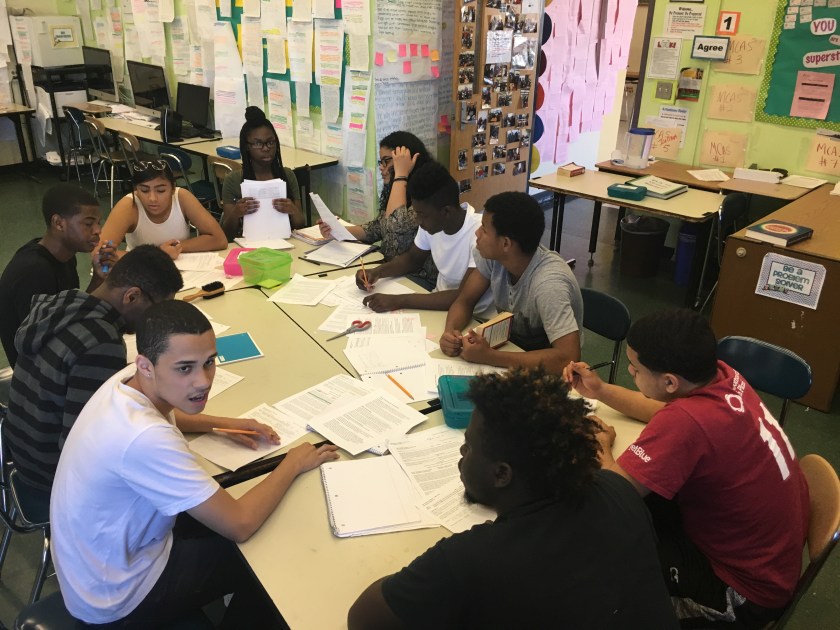 Within each lesson, I build in a clear beginning (with a Do Now activator), mini-lesson to model a skill or concept, activity using a specific strategy to engage students in academic discourse and student-centered learning, a check-in as a self-assessment and formative assessment for my understanding of student progress, and a closing that often includes a debrief of the activity. Closings may include a brief writing reflection, partner talk, open circle whole-class reflection, or a completed Criteria for Success utilized as an exit ticket. One example of a closing is the use of an Open Circle structure to provide a space for the whole-class to reflect in response to a question that debriefs the activity. The use of open circle in my classroom is one example of ensuring that equity of voice is present in each lesson. This allows space to build students’ agency with learning as each student learns to contribute to the classroom community. In the example linked below, I developed an Open Circle debrief to a storytelling protocol with the Powerful Moment Protocol Debrief Questions.

 180newbeginnings.com